
Journal Information
Article Information
한국 부모의 양육작업에 대한 범위 문헌고찰: 개념화, 구성요소 및 평가 접근 분석
Author Information
Objective: This scoping review examined how parenting occupations among Korean parents were conceptualized and assessed using the Parenting Occupations and Purposes (POP) Framework.
Methods: PubMed, Web of Science, Embase, Research Information Sharing Service, and Korea Citation Index were searched through April 10, 2026. Studies describing parenting activities, tasks, practices, participation, role responsibilities, time use, or parent–child interactions in Korean contexts at the item or observational level were included. Fourteen studies were analyzed and mapped to the 10 POP domains.
Results: Of 14,326 records, 14 studies were included. Parenting occupations were addressed through parenting behavior, practices, participation, role responsibilities, time use, and parent–child interactions. Four approaches were identified: occupation- or doing-based, behavior-based, practice-based, and role- or participation-based. All 10 POP domains were represented, with evidence concentrated in communication, learning facilitation, emotional support, supportive environments, and play or leisure; mobility support, material provision, and social network management were limited. Most assessments relied on self-report scales.
Conclusion: Korean parenting occupations were reflected in diverse everyday tasks but were insufficiently established as occupational constructs. Performance context, occupational balance, and difficulty were limited in existing assessments. These findings support future occupation-based assessment and intervention research.
목적: 본 연구는 0–18세 자녀를 둔 한국 부모의 양육작업이 국내 문헌에서 어떻게 개념화·구성·평가되어 왔는지를 범위 문헌 고찰을 통해 탐색하고, 이를 Parenting Occupations and Purposes (POP) Framework 의 관점에서 재해석하고자 하였다.
방법: PubMed, Web of Science, Embase, Research Information Sharing Service, Korea Citation Index를 이용하여 출판연도 제한 없이 2026년 4월 10일까지 문헌을 검색하였다. 0–18세 자녀를 둔 한국 부모 또는 한국적 양육 맥락에서 부모의 양육 활동, 과업, 실천, 참여, 역할 책임, 시간 사용 또는 부모–자녀 상호작용을 문항·관찰항목 수준에서 제시한 학술지 원저 연구를 포함하였다. 최종 선정된 문헌을 대상으로 개념화 접근, 구성요소, 평가 특성을 분석하고, POP Framework의 10개 양육작업 영역에 매핑하였다.
결과: 총 14,326편의 문헌이 검색되었고, 중복 제거 및 제목·초록·원문 검토를 거쳐 최종 14편이 분석에 포함되었다. 한국 부모의 양육작업은 양육행동, 양육실천, 양육참여, 역할 책임, 시간 사용, 부모–자녀 상호작용 등 인접 개념을 통해 다루어지고 있었다. 개념화 접근은 작업/수행 기반, 행동 기반, 실천 기반, 역할·참여 기반의 4개 범주로 정리되었다. POP Framework의 10개 영역 모두에 구성요소가 매핑되었으나, 의사소통, 학습 촉진, 정서적 지지, 지지적 환경, 놀이·여가 영역에 집중되었고, 이동 지원, 물질적 제공, 사회적 관계망 관리는 제한적으로 확인되었다. 평가 접근은 주로 자기보고식 척도에 의존하였다.
결론: 본 연구에서 분석한 국내 문헌은 한국 부모의 양육작업을 다양한 일상 과업으로 다루었으나, 이를 양육작업 관점에서 충분히 개념화하거나 체계적으로 평가하지 못하였다. 특히 이동 지원, 물질적 제공, 사회적 관계망 관리와 같이 한국 양육 맥락에서 중요할 수 있는 영역과 양육작업의 수행 맥락, 작업 균형, 수행상의 어려움은 기존 평가 접근에서 제한적으로 다루어졌다. 본 연구는 한국 부모의 양육작업을 작업 치료적 관점에서 체계화하고, 향후 작업 기반 평가도구 및 중재 연구를 위한 기초자료를 제공한다.
I.서 론
작업치료에서 작업(occupation)은 개인이 일상에서 수행 하는 의미 있고 목적 있는 활동으로, 개인의 역할, 정체성, 건 강, 삶의 질과 밀접하게 연결된다([American Occupational Therapy Association, 2020]; [Christiansen, 1999]). 양육 은 작업치료 실행체계 제4판(Occupational Therapy Practice Framework: Domain and Process, 4th ed.; OTPF-4)에서 수단적 일상생활활동(Instrumental Activities of Daily Living; IADL)에 속하는 작업으로, 자 녀의 발달적·생리적 욕구를 지지하기 위해 돌봄과 감독을 제공하는 과정으로 정의된다([American Occupational Therapy Association, 2020]). 이러한 관점에서 양육은 자녀를 돌보는 단순한 행위를 넘어, 부모가 일상에서 반 복적으로 수행하는 복합적이고 의미 있는 작업 영역이다. 따라서 양육은 부모와 자녀 모두의 일상, 건강, 발달, 삶 의 질을 구성하는 핵심 작업으로 이해될 수 있다([Pizzi & Richards, 2017]).
작업으로써의 양육은 최근 한국 사회의 변화 속에서 그 중요성이 더욱 부각 되고 있다. 한국 사회는 지속적인 저출산과 가족 규모의 축소를 경험하고 있으며([Index Nuri, 2025]; [Statistics Korea, 2025a]), 전체 아동 및 학생 수는 감소하는 반면, 자녀의 교육·발달과 건강한 성장 환경에 대한 부모의 경제적 투입과 국가 차원의 정 책적 지원은 확대되는 양상을 보이고 있다([Ministry of Health and Welfare, 2024], [2025]; [Statistics Korea, 2025b]). 부모는 자녀를 먹이고 입히는 기본적 돌봄뿐 아니라, 자녀와 놀이하고, 학습을 지원하며, 건강과 안전 을 관리하고, 일상 루틴을 조직하며, 사회적 관계와 환경 을 조정하는 다양한 활동을 수행한다([Hwang et al., 2021]; [Lim et al., 2022]). 부모의 시간 사용, 작업 균형, 양육 역할 책임, 부모 역할 만족도와 같은 차원에서 이러 한 활동들이 논의 되어왔다([Hong & Kim, 2014]; [Lee & Lee, 2014]).
국내 양육 관련 연구는 지속적으로 축적되어 왔으나, 부모가 실제 일상에서 수행하는 양육 과업을 작업의 관점 에서 체계적으로 설명하는 데에는 제한이 있다. 국내 학 계에서는 아동학, 심리학, 교육학, 가족학 등을 중심으로 부모 양육행동, 양육태도, 양육스트레스, 아버지 양육참 여 등 다양한 양육 관련 연구가 수행되어 왔다([Chi et al., 2024]; [Kim & Lee, 2022]; [Lee & Lim, 2021]). 그러나 기존 문헌은 양육을 주로 양육행동(parenting behavior), 양육태도 또는 양육방식(parenting attitude/ style), 양육효능감, 양육스트레스와 같은 심리사회적 구 성개념으로 이해하고 측정하는 경향이 있었다([Chi et al., 2024]; [Kim & Yoon, 2021]). 특히 온정, 통제, 감독, 애정, 합리적 설명, 방임, 과잉간섭 등 부모의 양육방식이 나 자녀가 지각한 부모의 양육행동을 중심으로 연구가 이루어졌으며, 양육스트레스 및 양육행동 관련 연구에서 는 어머니를 주요 응답자 또는 주 양육자로 다루는 경향 이 반복적으로 나타났다([Huh, 2004]; [Kim & Lee, 2022]; [Kwon, 2011]; [Lee & Lee, 2014]). 이러한 연구들 은 부모의 심리적 특성, 부모–자녀 관계, 자녀 발달과의 관련성을 설명하는 데 기여하였다. 그러나 부모가 실제 일상생활에서 무엇을 수행하는지, 어떤 양육 과업이 반 복적으로 이루어지는지, 그리고 이러한 과업이 어떻게 구성·평가될 수 있는지에 대해서는 상대적으로 충분히 정리되지 않았다([Chi et al., 2024]; [Lim et al., 2022]). 따라서 작업치료적 관점은 부모의 양육을 태도나 심리적 특성만이 아니라, 실제 일상에서 수행되는 작업, 환경, 역할, 루틴, 참여 맥락 속에서 분석할 수 있는 틀을 제공한 다([American Occupational Therapy Association, 2020]; [Lim et al., 2022]).
평가도구 측면에서도 공백을 보이는데, 국내에는 부모 의 양육태도, 양육행동, 양육효능감, 양육스트레스 등을 평가하는 도구와 연구가 다수 존재하지만, 이들 도구는 대체로 부모의 신념, 정서, 태도, 자녀에 대한 인식, 양육 방식의 긍정성·부정성을 측정하는 데 초점을 두어 왔다 ([Cho & Lee, 2007]; [Huh, 2004]; [Jeong & Shin, 2011]). 반면 부모가 실제 환경 속에서 수행하는 양육 과업의 종 류, 빈도, 질, 맥락, 수행상의 어려움, 작업수행 만족도, 작업 균형을 평가하는 작업 기반(occupation-based) 접근은 상대적으로 제한적이어서, 부모의 실제 양육수행 을 포괄적으로 파악하고 이를 평가도구 개발로 연결하는 데 한계가 있다([Law et al., 2019]; [Lim et al., 2022]). 또한 ‘양육실천’, ‘양육참여’, ‘양육역할 책임’, ‘부모–자 녀 상호작용’ 등의 개념은 국내 문헌에서 각각 별도의 구성개념과 측정 틀로 사용되어 왔으나, 이들이 작업치 료에서 말하는 양육작업(parenting occupation) 또는 ‘doing parenting’의 관점에서 어떻게 연결되거나 구분 되는지는 충분히 체계화되지 않았다([Hwang et al., 2021]; [Kim & Jang, 2010]; [Lim et al., 2022]).
[Lim 등(2022)]은 양육을 작업 치료적 관점에서 설명하 기 위한 이론적 틀로 양육 작업 및 목적(Parenting Occupations and Purposes; POP) Framework를 제 안했다. POP Framework는 양육을 심리적 태도나 관계 양식이 아니라, 부모가 자녀를 위해 수행하는 구체적인 작업과 그 작업이 지향하는 목적으로 구조화하며, 자녀 의 기본적 욕구 충족, 이동 지원, 물질적 제공, 건강관리 와 보호, 의사소통, 놀이와 여가 참여, 정서적 지지와 안 정 제공, 학습 촉진, 지지적 환경 조성, 사회적 관계망 관리의 10개 양육작업 영역을 포함한다. 다만 POP Framework는 서구의, 그리고 주로 어머니와 영유아를 대상으로 한 작업치료 문헌에서 귀납적으로 도출되었으 며, [Lim 등(2022)]은 문화적 다양성, 아버지, 연장 아동을 포괄하는 후속 연구의 필요성을 스스로 한계로 제시하였 다. 실제로 [Lim 등(2022)]의 고찰에 포함된 문헌은 어머 니와 어린 자녀를 중심으로 한 서구 문화권 연구에 집중 되어 있었고, 저자들은 아버지, 다양한 연령대의 자녀, 부모의 장애와 건강 상태, 사회문화적 배경을 포괄하는 연구가 더 필요하다고 제안하였다. 양육작업은 사회문화 적 기대, 가족구조, 교육 및 돌봄 환경, 부모 역할에 대한 규범에 따라 수행 방식과 우선순위가 달라질 수 있으므 로, POP Framework가 한국 양육 문헌에서 어떤 영역 을 충분히 설명하고 어떤 영역을 제한적으로 포착하는지 검토할 필요가 있다. 따라서 본 연구는 [Lim 등(2022)]에 서 제시된 문화적 다양성 및 대상자 대표성의 한계를 고 려하여, 한국 부모의 양육작업을 어머니에 국한하지 않 는 부모 공동의 작업 영역으로 검토하고자 한다.
이에 본 연구는 한국 부모의 양육작업에 대한 체계적 이해와 작업 치료적 평가·중재의 기반을 마련하고자, 범위 문헌고찰을 통해 국내 문헌에서 한국 부모의 양육작 업이 어떻게 개념화·구성·평가되어 왔는지를 포괄적 으로 탐색하고자 한다. 특히 부모가 실제로 수행하는 활 동·과업·실천을 다룬 문헌을 중심으로 양육작업의 구 성요소와 평가 접근을 분석하고 이를 POP Framework 의 관점에서 재해석하며, 양육을 심리적 태도나 양육방 식으로 측정해 온 연구들은 그 자체를 재해석 대상으로 삼기보다 국내 양육 연구의 지형을 보여주는 배경으로 다룬다. 본 연구의 핵심 질문은 “국내 문헌에서 한국 부모 의 양육작업은 어떻게 개념화되어 있으며, 이는 작업치 료적 관점, 특히 POP Framework를 통해 어떻게 재구 성될 수 있는가?”이다. 이를 통해 본 연구는 향후 한국 부모의 양육작업을 체계적으로 평가할 수 있는 작업 기반 평가도구 개발의 기초 자료를 제공하고자 한다.
II.연구 방법
1.연구 설계
본 연구는 국내 문헌에서 한국 부모의 양육작업과 관 련된 개념, 구성요소 및 평가 특성이 어떠한 방식으로 다루어져 왔는지를 포괄적으로 고찰하기 위해 수행한 범 위 문헌고찰(scoping review)이다. 본 연구의 목적은 양육작업의 효과를 검증하는 것이 아니라 양육작업이 어 떻게 개념화·구성·평가되어 왔는지를 통합적으로 조 망하는 데 있다. 따라서 특정 주제의 근거 범위와 특성을 지도화하고, 핵심 개념을 명료화하며, 연구의 공백을 규 명하는 데 적합한 범위 문헌고찰을 설계로 채택하였다 ([Arksey & O'Malley, 2005]; [Munn et al., 2018]).
본 연구는 [Arksey와 O'Malley (2005)]가 제안하고 [Levac 등(2010)]이 보완한 범위 문헌고찰의 절차적 틀과 Joanna Briggs Institute (JBI)의 범위 문헌고찰 방법론 에 따라 (1) 연구 질문 설정, (2) 관련 문헌 검색, (3) 문헌 선정, (4) 자료 추출(charting), (5) 결과의 정리·요약·보고의 5단계로 수행하였으며([Peters et al., 2020]), [Levac 등(2010)]이 제안한 선택적 자문(consultation) 단계는 포함하지 않았다. 연구 질문과 선정 기준은 JBI가 권고하는 Population, Concept, Context (PCC) 형식 으로 구조화하였고, 보고는 Preferred Reporting Items for Systematic Reviews and Meta-Analyses extension for Scoping Reviews (PRISMA-ScR)에 따 라 작성하였다([Tricco et al., 2018]).
2.문헌 검색 및 선정 기준
문헌 검색은 한국 부모의 양육작업과 관련된 국내외 문헌 을 포괄적으로 탐색하기 위해 PubMed, Web of Science, Embase, 학술연구정보서비스(Research Information Sharing Service; RISS), 한국학술지인용색인(Korea Citation Index; KCI)을 이용하였다. 최종 검색은 2026년 4월 10일에 수행하였으며, 출판연도에는 제한을 두지 않았 다. 국외 데이터베이스에서는 부모 관련 검색어(“parent”, “caregiver”, “mother”, “father”), 양육 관련 검색어 (“parenting activity”, “parenting occupation”, “parenting task”, “parenting behavior”, “parenting practice”, “child-rearing”), 개념화 및 평가 관련 검색어(“concept”, “framework”, “domain”, “component”, “dimension”, “assessment”, “measurement”, “instrument”, “scale”) 를 조합하여 각 데이터베이스의 검색 필드에 맞추어 동일 한 핵심 개념 구조를 적용하였다. 국내 데이터베이스에 서는 한국어 검색어 특성과 데이터베이스의 검색 기능을 고려하여 분할 검색을 수행하였고, (“부모” AND “양육” AND “개념”), (“부모” AND “양육” AND “구성요소”), (“부모” AND “양육” AND “평가”), (“부모” AND “양육” AND “측정”), (“부모” AND “양육” AND “척도”), (“부 모” AND “양육작업”), (“부모” AND “양육” AND “작업 치료”), (“부모” AND “작업치료”)의 조합과 보완 검색어 로 (“부모” AND “양육코칭”)을 사용하였다. 국외 데이터 베이스 검색에서는 관련 문헌의 누락을 최소화하기 위해 국가명 제한어를 검색식에 포함하지 않았으며, 한국 부 모 또는 한국적 양육 맥락 여부는 이후 문헌 선정 과정에 서 판단하였다.
본 연구의 문헌 선정 기준은 PCC framework에 따라 설정하였다. Population은 0–18세 자녀를 둔 한국 부모 로 정의하였다([Lim et al., 2022]). Concept는 부모가 자녀를 위해 수행하는 양육작업으로 정의하되, 양육 활 동·과업·실천·역할·시간 사용·부모–자녀 상호작 용 등 부모의 실제 수행이 문항(item) 수준에서 관찰·기 술 가능한 행위로 조작화된 경우에 한정하였다. Context는 한국 사회 또는 한국 연구 환경에서 수행된 연구로 설정하였다. 본 연구의 구체적 선정·배제 기준 은 다음과 같다.
1)선정 기준
(1) 0–18세 자녀를 둔 한국 부모 또는 한국적 양육 맥 락을 대상으로 한 연구
(2) 부모의 양육 활동, 과업, 실천, 참여, 역할 책임, 시간 사용 또는 부모–자녀 상호작용을 문항·관찰 항목 수준에서 확인할 수 있는 연구
(3)양육의 개념화, 구성요소, 영역, 평가 또는 측정 방 법에 관한 정보를 제시한 학술지 원저 연구
(4) 한국어 또는 영어로 출판된 연구
2)배제 기준
(1) 한국 부모 또는 한국적 양육 맥락이 확인되지 않는 연구
(2) 부모의 행위·과업·활동이 문항 수준에서 확인되 지 않고, 양육태도, 양육방식, 양육 효능감, 양육스 트레스, 양육 신념 등 잠재적 심리 구성개념만을 측정한 연구
(3)양육이 독립·종속·매개변수로만 사용되고, 양 육 자체의 개념화·구성요소·평가 접근을 주요 목적으로 다루지 않은 연구
(4)고찰 논문, 메타분석, 학위논문, 단행본, 학술대회 발표자료, 포스터 등 학술지 원저 연구가 아닌 문헌 및 원문 확인이 불가능한 연구
3.문헌 선정 과정
문헌 검색 결과, 총 14,326편의 문헌이 검색되었다 (PubMed 2,967편, Web of Science 5,107편, Embase 3,365편, RISS 2,660편, KCI 227편). 데이터베이스 내 중복 712편과 데이터베이스 간 중복 5,138편을 제거한 후 8,476편을 제목 및 초록 검토 대상으로 선정하였다. 제목 검토에서 본 연구 주제와 관련성이 낮은 문헌을 제 외하고, 초록 검토를 통해 30편의 문헌을 원문 검토 대상 으로 선정하였다. 문헌 선정의 핵심 기준은 Concept (C) 이며, 제목·초록 단계에서는 양육행동·양육실천·양 육참여 관련 문헌 중 C 기준 충족 여부를 명확히 판단하 기 어려운 문헌도 원문 검토 대상에 포함하였다([Polanin et al., 2019]). 검토 단계에서는 각 문헌의 조작적 정의, 측정도구, 하위영역, 그리고 문항(item) 내용을 함께 확 인하여 C 기준을 보다 구체적으로 적용하였다. 구체적으 로 측정 문항이 부모가 실제로 수행하는 관찰·기술 가 능한 양육 행위·과업·활동(예: 함께 놀이하기, 규칙을 설명하기, 식사 준비하기)을 기술하는 경우에는 보고 주 체(부모 자기보고 또는 자녀 지각)와 무관하게 포함하였 다. 심리사회적 구성개념(예: 온정, 통제, 감독)으로 명명 된 하위요인이라도 문항이 부모의 구체적 행위·과업을 기술하는 경우 양육작업 관련 내용으로 판단하였다. 반 면 온정–통제와 같은 전반적 양육태도, 양육효능감, 양육 스트레스 등 심리 구성개념만을 측정한 연구는 제외하였 다. 문헌 선정은 연구자 간 일관성을 확보하기 위해 선정·배제 기준을 사전에 합의한 후 수행하였으며, 기준 적용 이 모호한 문헌은 연구자 간 논의를 통해 최종 포함 여부 를 결정하였다.
원문 검토 결과 총 16편의 문헌이 제외되었다. 제외 사유는 부모의 행위 수준 양육 수행 내용이 확인되지 않 은 연구 12편, 양육의 개념화·구성요소·영역·평가 또는 측정이 연구의 주요 초점이 아닌 연구 3편, 고찰 또는 원저 연구가 아닌 문헌 1편이었다. 최종적으로 본 연구의 선정 기준에 부합하는 14편의 문헌을 분석 대상 에 포함하였다. 문헌 선정 과정은 PRISMA-ScR 지침에 따라 Figure 1에 제시하였다([Tricco et al., 2018]).
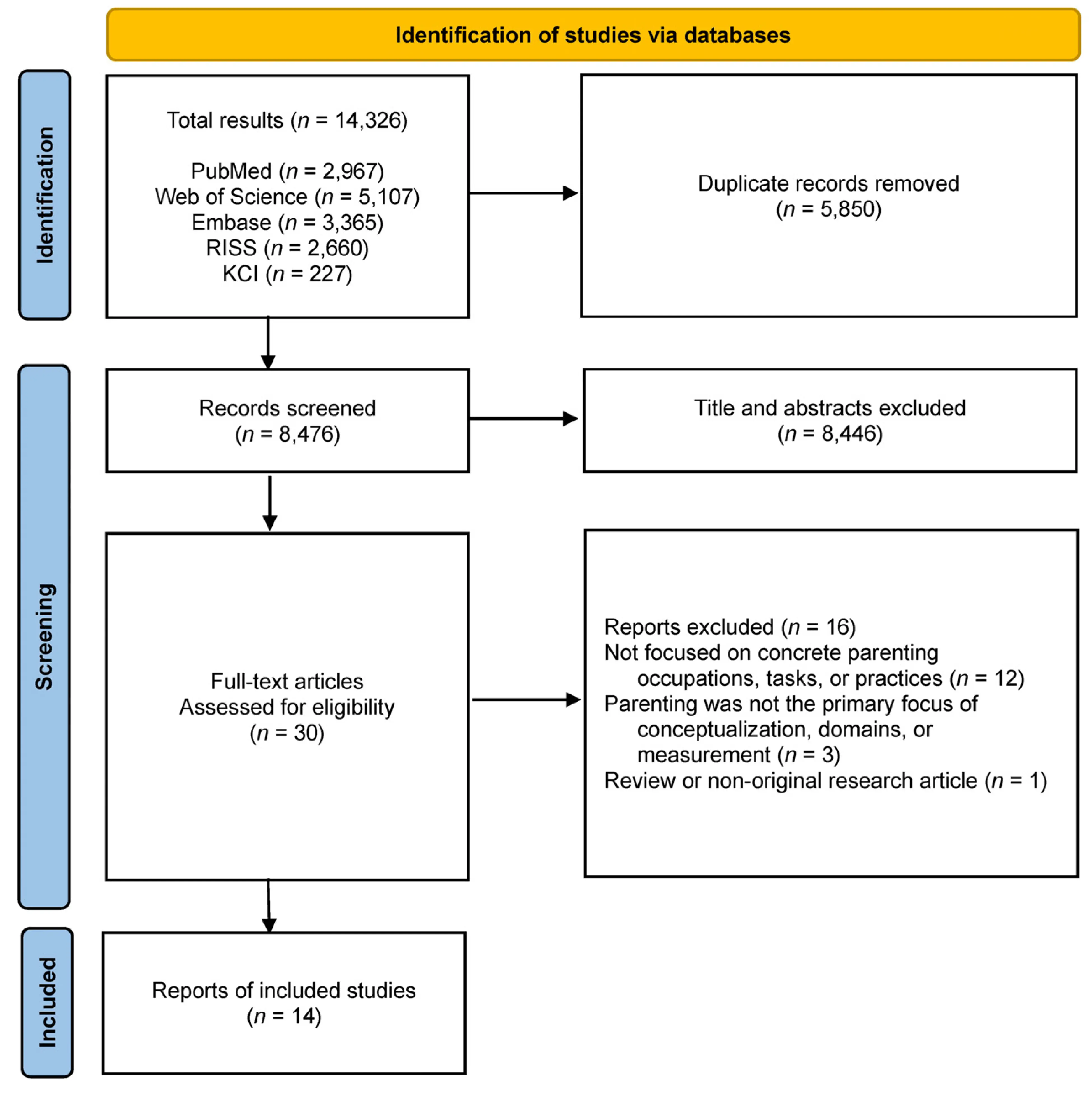 Figure 1.PRISMA-ScR Flow Diagram
4.문헌 분석
최종 선정된 14편의 문헌은 연구목적과 연구질문에 근거하여 개발한 자료추출 양식(data charting form)을 통해 분석하였으며, 해당 양식은 예비 추출 과정에서 추 출 항목의 적절성과 일관성을 검토한 후 보완하였다 ([Levac et al., 2010]). 항목에는 저자, 출판연도, 자료원, 연구 설계, 연구목적, 연구대상자, 자녀 특성, 양육 관련 구성개념, 개념화 접근, 하위영역 및 구성요소, 측정도구와 평가방식, 심리측정학적 근거, 주요 결과가 포함되었다.
양육 관련 구성개념은 각 문헌에서 사용한 용어와 조작 적 정의를 중심으로 추출하였다. “parenting behavior”, “parenting practice”, “parenting participation”, “parental role responsibility”, “parent–child interaction”, “time use” 등으로 제시된 개념을 확인하 고, 해당 개념이 부모의 실제 수행, 역할 책임, 관찰 가능 한 상호작용, 부모 보고 또는 자녀 지각에 근거한 행위 수준 양육 내용 중 어디에 초점을 두는지를 분석하였다. 개념화 접근은 (1) 작업/수행 기반 접근(occupation-/ doing-based), (2) 행동 기반 접근(behavior-based), (3) 실천 기반 접근(practice-based), (4) 역할·참여 기반 접근(role-/participation-based)의 4개 범주로 분류하였다. 이 4개 범주는 기존 이론에서 고정적으로 제시된 분류가 아니라, 포함문헌의 주된 측정 초점과 구 성요소를 비교하여 본 연구에서 도출한 분석 범주이다. 양육작업의 구성요소는 각 문헌의 하위요인, 영역, 문항 또는 관찰항목을 중심으로 추출하였다. 척도 개발 및 타 당화 연구의 경우 최종 요인 구조와 문항을, 관찰평가 연구의 경우 평가 영역과 관찰 가능한 상호작용 행동을, 시간사용 연구의 경우 양육이 포함된 작업 영역과 시간 측정 방식을 중심으로 추출하였다. 평가 및 측정 접근은 도구명, 문항 수, 응답자·관찰자, 평가방식, 신뢰도·타 당도 검증 여부를 중심으로 정리하였다.
추출된 양육 관련 구성요소는 [Lim 등(2022)]의 POP Framework의 10개 양육작업 영역을 기준으로 매핑하 였다. 두 명의 연구자가 독립적으로 각 문헌의 하위영역 또는 문항을 양육작업 목적과 수행 맥락에 따라 10개 영역에 배정하였으며, 불일치 항목은 논의 또는 제3 연구 자 자문으로 결정하였다. 하나의 구성요소가 복수 영역 에 해당할 수 있는 경우 주된 목적과 수행 맥락을 기준으 로 우선 매핑하였다. 본 연구에서는 학대, 방임, 과잉간 섭, 강압적 훈육, 체벌, 식사 강요 등 자녀의 참여와 발달 을 지지하기보다 통제적·비지지적 양육행동으로 해석 되는 항목은 POP의 지지적 양육작업 영역에 직접 매핑 하지 않고, 양육작업의 부적응적 수행 또는 비지지적 양 육실행으로 별도 기술하였다. 14편 문헌의 대표 itemlevel POP 매핑과 부적응적 또는 비지지적 양육항목은 POP Framework의 10개 영역을 기준으로 정리하여 하 나의 부록 표로 제시하였다(Table A1).
III.연구 결과
1.포함된 연구의 일반적 특성
최종 선정된 14편의 문헌은 2002년부터 2026년까지 출판되었다. 연구설계는 척도 개발 및 타당화 연구가 가 장 많았으며, 관찰 기반 부모–아동 상호작용 평가모형 연구, 혼합연구, 횡단적 설문연구가 포함되었다. 연구대 상은 어머니, 아버지, 부모–자녀 쌍, 자녀가 지각한 부모 의 양육행동을 보고한 아동·청소년으로 구성되었다. 자 녀의 연령은 영아기부터 청소년기까지 분포하였으며, 일 부 연구는 정서·발달 문제를 가진 취학 전 아동 또는 장애아동의 어머니를 대상으로 하였다. 포함문헌의 일반 적 특성은 Table 1에 제시하였다.
| Author (year) | Study design | Aim/purpose | Sample/participants | Child characteristics |
|---|---|---|---|---|
| [Bang et al. (2026)] | Cross-sectional survey | Time use and time deficiency | Mothers, n = 210 | Children with and without disabilities |
| [Song & Kim (2002)] | Observational case analysis | Free-play interaction assessment model | Mother–child dyads; 18 children, 24 cases | Preschool children with emotional/developmental concerns |
| [Song & Seo (2002)] | Observational assessment model development | Structured interaction assessment model | Parent–child dyads; 18 children, 30 cases | Preschool children with emotional/developmental concerns |
| [Lim & Chung (2004)] | Inventory development and validation | Korean parenting inventory development | Adolescents, n = 780 | Middle and high school students |
| [Huh (2004)] | Inventory development and validation | Parenting behavior inventory development | Adolescents, n = 1,461 | Middle and high school students |
| [Kim & Jang (2010)] | Mixed-methods study | Paternal involvement and child-perceived images | Father–child dyads, n = 140 | Preschool children aged 4–5 years |
| [Kang & Kwon (2014)] | Scale standardization and validation | Korean APQ standardization | Parents, n = 419 | Children aged 5 years to grade 3 |
| [Rhee & Doh (2014)] | Scale development and validation | Parenting behavior scale development | Mothers, n = 1,557 | Children in grades 1–3 |
| [Kim (2017)] | Pilot tool development study | Korean CRKS/CRPS adaptation | Mothers, n = 20 | Infants |
| [Kwon & Seo (2018)] | Scale development and validation | Parenting behavior scale development | Parents, n = 505 | Children aged 5–16 years |
| [Kim & Suh (2018)] | Scale development and validation | Children’s participation-respecting parenting scale development | Mothers, n = 284 | Children aged 3–5 years |
| [Hwang et al. (2021)] | Scale development and validation | Parental role responsibilities scale development | Parents, n = 301 | Infants and young children |
| [Son & Song (2022)] | Scale translation and validation | K-CFPQ validation | Mothers, n = 434 | Children aged 2–6 years |
| [Kim (2024)] | Observational scale development and validation | Rough-and-tumble play interaction scale development | Father–child dyads, n = 60 | Children aged 3–5 years |
2.양육작업의 개념화 및 구성요소
포함문헌에서 양육작업은 단일 용어로 개념화되기보 다, 양육행동, 양육실천, 양육참여, 부모–자녀 상호작용, 양육 역할 책임, 시간 사용 등 다양한 구성개념을 통해 조작화되고 있었다. 본 연구는 각 문헌의 주요 구성개념, 조작적 정의 및 측정방식을 기준으로 개념화 접근을 작업 /수행 기반, 행동 기반, 실천 기반, 역할·참여/책임 기 반의 4개 범주로 분류하였다(Table A2). 작업/수행 기반 접근은 부모가 실제로 수행하는 작업, 시간 사용, 관찰 가능한 부모–자녀 상호작용을 중심으로 양육을 다룬 연 구에서 확인되었다. [Bang 등(2026)]은 어머니의 시간 사 용을 OTPF-4의 작업 영역에 따라 분석하고, 양육을 포 함한 IADL을 수행 시간의 차원에서 다루었다. [Song과 Kim (2002)]은 자유놀이 상황에서 주도성, 함께 놀이하 기, 정서적 유대, 놀이의 즐거움을 관찰하였으며, [Song 과 Seo (2002)]는 구조화된 상호작용 과제에서 구조화, 민감성, 놀이, 학습, 양육, 정서, 시각적 관여를 평가하였 다. [Kim (2024)]은 아버지–유아의 거친 신체놀이 상호작 용을 루브릭 기반 관찰평가로 측정하였다.
행동 기반 접근은 부모의 양육을 행동 차원의 요인 구 조로 제시한 연구에서 주로 확인되었다. 대표적으로 [Huh (2004)]는 청소년이 지각한 부모 양육행동을 감독, 합리적 설명, 비일관성, 과잉기대, 과잉간섭, 학대, 방치, 애정의 8개 요인으로 제시하였고, [Rhee와 Doh (2014)] 는 학령 초기 자녀 부모의 양육행동을 온정, 합리적 설명, 개입, 강압, 방임의 5개 요인으로 구조화하였다. 또한 [Kang과 Kwon (2014)]은 한국판 Alabama Parenting Questionnaire를 통해 보상, 처벌, 관여, 비관여 군집을 제시하였으며, [Kwon과 Seo (2018)]는 훈육, 온정 및 지 지, 존중, 비난 및 공격, 부적절한 역할모델, 비일관성, 간섭, 방임 등을 포함한 부모 양육행동 요인을 제시하였 다. 선행연구에서는 유아의 참여권을 존중하는 부모 양 육행동을 참여 인식 및 의견표현, 의견존중, 정보제공, 사회참여의 4개 요인으로 구조화하였다([Kim & Suh, 2018]).
실천 기반 접근은 특정 양육 맥락에서 부모가 반복적 으로 수행하는 구체적 실천을 다룬 연구에서 확인되었다. [Kim (2017)]은 영아 부모의 양육실천 도구를 통해 수유, 성장과 발달, 청결과 보호, 영아 자극 등 영아기 돌봄 실천 을 다루었다. [Son과 Song (2022)]은 한국형 포괄적 식사양 육 실행척도(Korean version of the Comprehensive Feeding Practices Questionnaire)를 통해 정서조절, 건강한 식사지도, 식사환경, 음식을 사용한 보상, 모델링, 모니터링, 먹기 압박, 체중 조절을 위한 제한 등 식사 상황에서 나타나는 부모의 실행을 측정하였다. 역할·참 여/책임 기반 접근은 부모의 양육참여 영역이나 양육 역 할 책임을 중심으로 양육을 설명한 연구에서 확인되었다. [Kim과 Jang (2010)]은 아버지의 양육참여를 일상생활 지도, 학습지도, 여가활동, 가사활동의 4개 영역으로 제 시하였다. [Hwang 등(2021)]은 부모의 양육 역할 책임을 위생관리, 신체활동, 생존 및 건강관리, 인지발달, 정서 적 안정감, 사회적 기술, 사회규범 및 가치관, 물리적 환 경, 보호, 가족공동체 의식과 가풍, 기관 이용 부모 역할 의 11개 요인으로 구조화하였다.
3.평가 및 측정 접근
포함문헌에서 양육작업 관련 개념은 주로 구조화된 척 도 또는 설문을 통해 평가되었으며, 일부 문헌에서는 시 간일지, 관찰평가, 면담 및 그림 자료가 활용되었다. 척도 기반 연구는 양육행동, 양육실천, 양육참여, 양육 역할 책임, 식사양육 실행 등 다양한 양육 관련 구성개념을 측정하였으며, 응답자는 연구목적에 따라 부모, 어머니, 아버지 또는 자녀·청소년으로 구성되었다(Table A2).
양육행동을 측정한 도구로는 한국형 양육 척도, 청소 년이 지각한 부모 양육행동 척도, 한국판 Alabama Parenting Questionnaire, 학령 초기 자녀 부모용 양 육행동 척도, 부모 양육행동 척도 등이 사용되었다([Huh, 2004]; [Kang & Kwon, 2014]; [Kwon & Seo, 2018]; [Lim & Chung, 2004]; [Rhee & Doh, 2014]). 이들 도구 는 대체로 부모 또는 자녀의 자기보고식 응답을 기반으로 양육행동의 빈도, 수준 또는 요인 구조를 평가하였다. 그 외 영아기 양육실천 도구, 식사양육 실행척도, 유아 참여 권 존중 양육행동 척도, 부모의 양육 역할 책임 척도 등도 확인되었다. 관찰 기반 평가는 부모–자녀 상호작용을 직 접 관찰하거나 구조화된 과제를 통해 평가한 연구에서 확인되었다. 자유놀이 상황의 부모–아동 상호작용 평가 모형은 주도성, 함께 놀이하기, 정서적 유대, 놀이의 즐거 움을 평가하였고, 구조화된 부모–아동 상호작용 평가모 형은 구조화, 민감성, 놀이, 학습, 양육, 정서, 시각적 관 여를 포함하였다([Song & Kim, 2002]; [Song & Seo, 2002]). 아버지–유아 거친 신체놀이 상호작용 척도는 아 버지와 유아의 놀이 상호작용을 루브릭 방식으로 평가하 였다([Kim, 2024]).
시간사용 기반 평가는 어머니의 하루 시간 사용을 작 업 영역별로 분석한 연구에서 확인되었다. [Bang 등(2026)]은 수정된 시간일지를 사용하여 activities of daily living, IADL, 건강관리, 휴식과 수면, 교육, 일, 여가, 사회참여 등 작업 영역별 시간 사용을 측정하였다. 심리측정학적 근거는 척도 개발 및 타당화 연구에서 주로 제시되었다. 다수 연구는 탐색적 요인분석, 확인적 요인 분석, 내적 일관성, 준거타당도, 수렴타당도 등을 보고하 였으며, 일부 번안·타당화 연구는 번역·역번역 절차, 검사–재검사 신뢰도, 내용타당도 등을 함께 제시하였다. 반면 시간사용 연구와 일부 관찰 기반 평가모형 연구는 표준화된 심리측정학적 검증보다 기존 조사도구의 수정, 임상적 관찰모형 또는 평가 절차 개발에 초점을 두었다.
4.POP Framework 기반 매핑 결과
포함된 14편 문헌에서 추출된 양육작업 구성요소를 POP Framework의 10개 영역에 매핑한 결과는 Table 2에 제시하였으며, item-level 상세 매핑은 Table A1에 제시하였다. 10개 영역 모두에 하나 이상의 활동이 매핑 되었으나, 영역별 매핑 밀도는 균등하지 않았다. 매핑 밀 도가 높은 영역은 자녀와 의사소통하기, 학습을 가르치 고 촉진하기, 정서적 지지와 안정 제공하기, 지지적 환경 조성하기, 놀이와 아동 중심 여가에 참여하기였으며, 다 양한 개념화 접근의 문헌에서 공통적으로 확인되었다. 중간 밀도 영역은 자녀의 기본적 욕구 돌보기(주로 영유 아 대상 문헌의 수유·위생·수면), 건강을 관리하고 위 험으로부터 보호하기(성장 모니터링·예방접종·식이 모니터링 등), 사회적 관계망 관리하기(또래·학교 관여 중심)였다. 매핑 밀도가 가장 낮은 영역은 자녀의 이동을 지원하기와 물질적으로 제공하기로, 시간사용 연구의 이 동 항목과 자녀 관련 구매·발달 자료 등에서만 부분적 으로 확인되었고 이를 독립적인 양육작업 구성요소로 평 가한 도구는 확인되지 않았다.
| Author (year) | Basic needs | Communication | Emotional support | Teaching/facilitation | Supportive environment | Social networks | Play/leisure | Health/protection | Material provision | Moving |
|---|---|---|---|---|---|---|---|---|---|---|
| [Bang et al. (2026)] | Child rearing (IADLs) | - | - | - | Home management | - | - | Communication with the healthcare system | - | Locomotion |
| [Song & Kim (2002)] | - | Verbal/nonverbal responses; reflective responses | Emotional bonding; positive touch; encouragement | - | Toy clean-up routine | - | Child-led free play; shared enjoyment | - | - | - |
| [Song & Seo (2002)] | Lotion care; feeding | Verbal guidance; task preparation | Affection; soothing; praise | Structured learning tasks; scaffolding | Task setup; environmental arrangement | - | Shared play; peekaboo; tickling | - | - | Physical positioning |
| [Lim & Chung (2004)] | - | Respect for opinions; explanation; daily check-ins | Affection; understanding; emotional restraint | Social norms; responsibility; manners | - | Awareness of friends/school life | - | Monitoring daily activities | - | - |
| [Huh (2004)] | - | Respect for opinions | Affection; encouragement; praise; shared time | Reasoning; explanation | - | - | - | Supervision/monitoring | - | - |
| [Kim & Jang (2010)] | Meal preparation; family meals | - | - | Daily living guidance; learning guidance | Housework support | - | pretend play / role-play | - | Grocery shopping | - |
| [Kang & Kwon (2014)] | - | Daily conversation; warm communication | Praise; reward; affection | Homework support; reasoning | School involvement; family events | Peer/school involvement | Shared games/play | - | - | Transport to activities |
| [Rhee & Doh (2014)] | - | Sharing childhood memories | Warmth; praise; friendly voice; shared warm time | Reasoning; rule explanation; perspective-taking | - | - | - | - | - | - |
| [Kim (2017)] | Feeding; hygiene; clothing; sleep | Talking to infant; family introduction | Soothing; lullabies | - | Safe sleep environment | - | Toy play | Growth monitoring; infection prevention; vaccination | - | - |
| [Kwon & Seo (2018)] | - | Verbal affection; perspective-taking | Physical affection; praise; empathy | Reasoning; rule explanation; problem-solving; responsibility | - | Peer-conflict listening | Shared play/time | - | - | - |
| [Kim & Suh (2018)] | Appearance choices | Listening; expression support | - | Information seeking; decision support | Expression-supportive atmosphere | Family events; peer relationships | Play rights; leisure/cultural activities | - | Child-related purchases | - |
| [Hwang et al. (2021)] | Hygiene; eating; self-care | Opinion sharing; explanation | Comfort; emotional stability; emotional needs | Cognitive development; values; social rules | Physical environment; routines; institution safety | Family/peer/institutional relationships | Physical play; play space | Health care; hygiene; safety; protection | Developmental materials/equipment | - |
| [Son & Song (2022)] | - | Nutrition discussion | - | Healthy eating guidance; modeling | Healthy food environment | - | - | Food intake monitoring | - | - |
| [Kim (2024)] | - | Observation; responsive help | Empathy; affection; enjoyment | Modeling; play support | - | - | Rough-and-tumble play | - | - | - |
한편 일부 포함 문헌에는 학대, 방임, 과잉간섭, 강압, 처벌, 부적절한 역할모델, 먹기 압박, 체중 통제 등 POP의 지지적 양육작업 영역에 직접 매핑하기 어려운 항목이 포 함되어 있었다. 본 연구는 이러한 항목을 POP의 지지적 양육작업 영역에 직접 매핑하지 않고, 양육작업의 부적응 적 수행 또는 비지지적 양육실행으로 별도 기술하였다.
IV.고 찰
본 연구는 범위 문헌고찰을 통해 국내 문헌에서 한국 부모의 양육작업이 어떻게 개념화·구성·평가되어 왔 는지를 탐색하고, 이를 POP Framework의 관점에서 재 해석하고자 수행되었다. 최종 14편의 문헌을 분석한 결 과, 한국 부모의 양육작업은 단일 용어로 통합되기보다 양육행동, 양육실천, 양육참여, 역할 책임, 시간 사용, 부 모–자녀 상호작용 등 인접 개념을 통해 다양하게 다루어 지고 있었으며, POP Framework의 10개 양육작업 영 역과 정합되는 구성요소들이 부분적으로 확인되었다.
먼저 개념화 측면에서 본 연구는 국내 문헌이 부모의 실제 수행보다 양육행동의 요인 구조와 빈도·수준을 측 정하는 방식에 상대적으로 의존해 왔음을 확인하였다. [Lim 등(2022)]이 양육을 부모가 실제로 수행하는 ‘doing parenting’의 관점에서 개념화한 것과 비교할 때, 국내 문헌은 연구 목적과 측정 초점에 따라 양육행동의 요인 구조와 빈도·수준을 중심으로 양육을 다룬 경우가 많았 다. 이에 따라 부모의 실제 양육수행을 작업 단위에서 명시적으로 구분하고 평가한 연구는 상대적으로 제한적 이었다. 본 연구가 도출한 네 가지 분석 범주는 국내 연구 가 양육작업을 어느 수준에서 포착하고 있는지를 보여준 다. 작업/수행 기반 접근은 시간 사용, 관찰 가능한 상호 작용, 실제 과업 수행을 중심으로 다룬다는 점에서 POP Framework의 occupation-based 관점과 가장 밀접 하게 연결된다. 행동 기반 접근은 구체적 행위를 포함할 수 있으나 양육행동의 요인 구조나 빈도·수준으로 환원 되는 한계가 있고, 실천 기반 접근은 반복적 양육 실행을 포착하지만 수행 목적·환경에 대한 설명이 제한적이며, 역할·참여/책임 기반 접근은 부모역할의 사회적·관계 적 차원을 반영하지만 일상 과업 수준의 분석으로 이어지 기에는 추상적이었다. 따라서 네 가지 범주는 국내 양육 문헌을 단순히 유형화한 결과가 아니라, 기존 연구를 POP Framework의 ‘doing parenting’ 관점에서 재해 석하는 분석적 틀로 이해될 수 있다([Chi et al., 2024]; [Lim et al., 2022]).
POP Framework와의 비교는 국내 양육문헌이 양육 작업의 일부 영역을 선택적으로 포착해 왔음을 보여준다. 본 연구에서 의사소통, 학습 촉진, 정서적 지지, 지지적 환경, 놀이·여가 영역은 상대적으로 두드러졌지만, 이 동 지원, 물질적 제공, 사회적 관계망 관리는 제한적으로 확인되었다. 특히 이동 지원은 POP Framework에서 독 립적인 양육작업 영역으로 제시되며 자녀 운송, 대중교 통 이용 지원, 활동 장소로의 이동 지원, 유모차 및 카시 트 사용 등을 포함하지만, 본 연구에 포함된 국내 문헌에 서는 등하원, 등하교, 학원 이동, 활동 참여를 위한 이동 보조 등 한국 양육 맥락에서 구체화될 수 있는 과업으로 충분히 평가되지 않았다. 물질적 제공 영역 또한 자녀 관련 구매나 발달 자료 제공 등 일부 항목으로만 다루어 져, 비용, 자원, 물품 관리와 같은 부모의 작업 수행 차원 은 제한적으로 반영되었다.
이러한 분포는 한국 사회의 양육 맥락과 관련지어 해 석할 필요가 있다. [Lim 등(2022)]은 양육작업이 사회경 제적 조건, 문화적 신념, 가족구조, 부모 자신의 양육경험 등 사회문화적 요인의 영향을 받는다고 보았으며, POP Framework 역시 양육작업과 양육 목적 전반에 걸친 사회문화적 맥락의 영향을 전제한다. 본 연구에서 학습 촉진, 의사소통, 정서적 지지 영역이 상대적으로 두드러 진 것은 한국 사회에서 자녀의 학업 성취, 부모의 교육적 관여, 부모–자녀 간 상호작용이 양육 연구와 정책의 주요 관심으로 다루어져 왔기 때문일 수 있다([Ministry of Health and Welfare, 2024]; [Statistics Korea, 2025b]). 반면 자녀의 이동 지원이나 물질적 제공은 실제 한국 부 모의 일상에서 중요한 양육 과업일 수 있음에도, 기존 문헌에서는 독립적인 양육작업 영역으로 충분히 개념화 되지 않았을 가능성이 있다. 예를 들어 등하원·등하교 지원, 학원 및 치료·교육기관 동행, 돌봄 자원 조정, 교 육비와 생활자원 제공은 한국 양육 맥락에서 반복적으로 수행되는 부모의 실제 과업일 수 있으나, 기존 연구에서 는 이를 부모의 작업수행으로 직접 측정하기보다 가족자 원, 양육환경 또는 사회경제적 배경으로 처리했을 가능 성이 있다. 따라서 본 연구의 POP Framework 기반 매핑 결과는 국내 문헌에서 특정 양육작업이 실제로 중요 하지 않다는 의미라기보다, 기존 연구와 평가도구가 어 떤 양육수행을 명시적으로 포착해 왔고 어떤 수행을 배경 적 조건으로 간주해 왔는지를 보여주는 결과로 해석되어 야 한다.
평가도구의 특성에서도 유사한 한계가 관찰되었다. 포 함문헌의 평가 접근은 부모 또는 자녀의 자기보고식 척도 에 크게 의존하였고, 관찰 기반 평가는 주로 영유아기 부모–자녀 상호작용에 한정되었으며, 시간사용 기반 평 가는 1편([Bang et al., 2026])에 국한되었다. 자기보고식 척도는 부모 또는 자녀가 인식한 양육행동의 빈도와 수준 을 파악하는 데 유용하지만, 실제 양육작업이 어떤 물리 적·사회적 맥락에서, 어떤 순서와 방식으로, 어떤 목적 을 위해 수행되는지를 직접 포착하기 어렵다. 따라서 향 후 한국 부모의 양육작업 평가에서는 구체적 행위·과업 수준의 자기보고 문항과 함께, 관찰평가, 시간사용 자료, 면담, 상황 기반 평가 등 다방법 접근을 통해 수행 맥락, 수행상의 어려움, 작업수행 만족도, 작업 균형을 통합적 으로 평가할 필요가 있다.
이러한 결과는 작업치료 연구 및 실천에 다음과 같은 함의를 제공한다. 첫째, 한국 부모를 대상으로 하는 작업 치료 평가와 중재를 설계할 때 POP Framework는 기존 국내 문헌에서 어떤 양육작업 영역이 강조되었고, 어떤 영역이 상대적으로 충분히 다루어지지 않았는지를 점검 하는 분석틀로 활용될 수 있다([Lim et al., 2022]). 특히 부모를 직접 대상으로 하는 작업치료 중재 모형인 Occupational Performance Coaching과 같은 접근 에서, POP Framework의 양육작업 영역은 부모와 함께 설정할 양육 목표를 구체화하는 좌표로 활용될 수 있다 ([Graham, 2011]). 또한 본 연구에서 매핑 밀도가 낮게 나타난 이동 지원, 물질적 제공, 사회적 관계망 관리 영역 은 향후 한국 부모의 양육작업 평가 및 중재 설계에서 우선적으로 검토할 필요가 있다. 둘째, 본 연구가 도출한 4개 개념화 범주는 향후 한국 부모를 대상으로 한 양육작 업 평가도구 개발에서 도구의 위치를 점검하는 좌표로 사 용될 수 있다. 즉 새로 개발되는 도구가 행동의 빈도를 평정 하는 데 머무는지, 부모의 실제 수행을 측정하는지, 양육의 실천 맥락을 반영하는지, 역할·참여 차원을 다루는지를 명확히 한 후 평가 영역을 설계할 필요가 있다. 셋째, 한국 부모의 양육작업을 평가할 수 있는 작업 기반 도구를 개발 하기 위해서는 [Lim 등(2022)]의 POP Framework에서 제 시한 10개 양육작업 영역을 포괄하되, 본 연구에서 상대 적으로 제한적으로 확인된 이동 지원, 물질적 제공, 사회 적 관계망 관리 영역과 작업 수행 맥락, 시간 사용, 작업 균형, 수행상의 어려움을 함께 반영할 필요가 있다. 이를 위해서는 한국 부모의 양육 일상을 직접 탐색하는 질적 연구, 영역의 적합성을 평가하는 델파이 연구, 그리고 작 업 기반 평가도구 개발 연구가 후속적으로 필요하다 ([DeVellis & Thorpe, 2021]; [Hasson et al., 2000]).
본 연구는 다음과 같은 제한점을 가진다. 첫째, 국내 데이터베이스로 RISS와 KCI를 사용하였으므로, Korean studies Information Service System·DBpia 등 일 부 국내 데이터베이스에만 색인된 문헌은 누락되었을 가 능성이 있으며, 이로 인해 한국 양육작업 관련 국내 문헌 의 전체 범위를 완전히 포괄하지 못했을 수 있다. 둘째, 양육행동(행위 수준 측정)과 심리적 양육태도(잠재적 심리 구성개념 측정)의 구분은 문항 단위의 해석적 판단에 의존 하므로 연구자 주관이 개입할 수 있다. 본 연구는 선정·배제 기준을 사전에 합의하고 모호 문헌은 연구자 간 논의 를 통해 결정하여 이를 보완하였으나, 분류 경계의 해석적 성격은 한계로 남는다. 셋째, POP Framework의 10개 양육작업 영역으로의 매핑은 두 명의 연구자가 독립적으 로 수행한 후 논의를 통해 합의하는 절차를 거쳤으나, Cohen’s kappa와 같은 정량적 평가자 간 신뢰도 분석 이나 외부 전문가 타당도 검증은 수행하지 않았다. 따라 서 후속 연구에서는 작업치료 전문가, 아동발달 전문가, 부모 당사자를 포함한 Delphi 조사 또는 전문가 타당도 평가를 통해 POP Framework 기반 매핑의 적절성과 문화적 타당성을 검토할 필요가 있다. 넷째, 본 연구는 범위 문헌고찰의 일반적 절차에 따라 포함된 14편의 근 거 질을 평가하지 않았으며, 결과 해석 시 이를 함께 고려 할 필요가 있다([Peters et al., 2020]). 다섯째, 본 연구는 한국 부모의 양육작업이 국내 문헌에서 어떻게 다루어져 왔는지를 매핑한 것이며, 양육작업의 효과나 영향을 비 교한 것은 아니다.
V.결 론
본 연구는 한국 부모의 양육작업이 국내 문헌에서 어떻 게 개념화·구성·평가되어 왔는지를 범위 문헌고찰을 통해 탐색하고, 이를 POP Framework의 관점에서 재해 석하였다. 그 결과 한국 부모의 양육작업은 양육행동, 양 육실천, 양육참여, 역할 책임, 시간 사용, 부모–자녀 상호 작용 등 인접 개념을 통해 다루어지고 있었으며, 개념화 접근은 작업/수행 기반, 행동 기반, 실천 기반, 역할·참 여 기반의 4개 범주로 정리되었다. POP Framework의 10개 양육작업 영역 모두에 한국 문헌의 구성요소가 부 분적으로 매핑되었으나, 의사소통·학습 촉진·정서적 지지·지지적 환경·놀이·여가 영역에 집중되어 있었 고, 이동 지원·물질적 제공·사회적 관계망 관리 영역 은 상대적으로 충분히 다루어지지 못하였다. 또한 평가 도구는 부모·자녀 보고식 척도에 의존하고 있었으며, 양육작업의 수행 맥락, 작업 균형, 수행상의 어려움을 통 합적으로 평가하는 작업 기반 접근은 제한적이었다. 본 연구의 결과는 한국 부모의 양육작업을 작업치료적 관점 으로 해석하고, 체계적으로 평가하기 위한 작업 기반 평 가도구 개발의 기초 자료로 활용될 수 있을 것이다.
References
Table A1. Item-Level Mapping of Parenting Activities and Observations From Included Studies to the Ten POP Domains, Including Maladaptive and Non-Supportive Items
| Study | POP domain | Activity / item content |
|---|---|---|
| [Bang et al. (2026)] | Basic needs | Child rearing (IADLs) |
| Supportive environment | Home management | |
| Health/protection | Communication with the healthcare system | |
| Moving | Locomotion | |
| [Song & Kim (2002)] | Communication | Verbal/nonverbal responses; reflective responses; empathic emotion responses (e.g., “Uses verbal and nonverbal responses to maintain the play activity”; “Reflects the child's play to support engagement”; “Responds empathically to the child's emotional expressions during play”) |
| Emotional support | Mutual gaze; positive touch; praise/encouragement; emotional bonding; shared enjoyment (e.g., “Gazes at the child's face and follows the child's gaze”; “Initiates positive physical contact”; “Encourages, praises, and supports the child's behavior”) | |
| Supportive environment | Post-play toy clean-up observation (e.g., “Directs the child to clean up toys after play and observes whether the child follows”) | |
| Play/leisure | Child-led toy choice; responsive engagement; harmonious physical/verbal interaction (e.g., “Provides opportunity for the child to choose toys”; “Plays harmoniously in physical, verbal, and emotional aspects”; “Matches the child's movement level”) | |
| Maladaptive | Four inappropriate domains, 16 items. Initiative (4): “Child does not explore toys”; “Parent persistently leads play through questioning/commanding”. Playing-together (4): “Parent participates in commanding, instructional, intrusive manner”; “Responds negatively to child's play”. Emotional-bonding (3): “No mutual gaze”; “Parent rejects physical contact”. Play-enjoyment (5): “Parent shows angry, aggressive behavior”; “No shared enjoyment” | |
| [Song & Seo (2002)] | Basic needs | Lotion care; feeding with affection (e.g., “Apply lotion on the child” — physical contact + responsive caregiving; “Feed the child snacks” — food responsive to needs) |
| Communication | Eye contact + behavior responsiveness; explain absence; verbal task preparation; birth-related emotional conversation and wishes for the child (e.g., “Makes eye contact during play”; “Explains the parent's absence and suggests activities the child can do alone”; “Verbally prepares the child for tasks”) | |
| Emotional support | Emotional/verbal affection; soothing tension; praise mistakes; shared enjoyment (e.g., “Expresses emotional affection — smile, eye contact”; “Recognizes the child's tense emotion and soothes”; “Responds positively when the child makes a mistake”) | |
| Teaching/facilitation | Block building; drawing; level-appropriate tasks; supportive responses (e.g., “Builds structure with blocks and has child build the same”; “Demands tasks appropriate to child's level; supports and encourages”) | |
| Supportive environment | Task preparation; environmental organization; material arrangement (e.g., “Verbally prepares the child for tasks and organizes the environment”; “Arranges materials within the child's reach and sets limits”) | |
| Play/leisure | Toy play; peekaboo; tickling; level-appropriate selection (e.g., “Play enjoyably with toys together”; “Play peekaboo with the child”; “Selects play appropriate to developmental level”) | |
| Moving | Seating child appropriately; physical guidance for tasks (e.g., “Seats the child in an appropriate location”; “Physically guides the child to perform the task”) | |
| Maladaptive | Seven inappropriate domains. Structure: parent presents tasks inefficiently. Sensitivity: fails to recognize child's emotions. Play: directs play as if it were learning. Learning: excessive demands; criticizes mistakes. Caregiving: perfunctory lotion application/feeding without emotional engagement. Emotion: negative expressions; expressionless face. Visual: gaze avoidance | |
| [Lim & Chung (2004)] | Communication | Respect for opinions; family decision-making; mutually acceptable alternatives; explanation for discipline; daily check-ins (e.g., “Respects my opinion even when disagreeing”; “Considers my opinion when setting rules related to me”; “Asks about my daily routine”; “Explains why I am being scolded”) |
| Emotional support | Generational understanding; importance/love expression; physical affection; emotional restraint (e.g., “Tries to understand the adolescent generation”; “Makes me feel I am important to mother”; “Hugs me or pats my shoulder”) | |
| Teaching/facilitation | Social norms; help others; promise-keeping; family events; speech; empathy (e.g., “Teaches me not to harm others”; “Tells me to help when someone needs help”; “Makes me keep my promises”; “Teaches me to consider others' feelings”) | |
| Social networks | Knows friends; romantic friend awareness; school life interest (e.g., “Knows who my friends are”; “Knows whether I have a romantic friend”; “Takes interest in my school life”) | |
| Health/protection | After-school location/route awareness; activity monitoring (e.g., “Calls when I am home alone and parent goes out”; “Knows my after-school activities and travel route”; “Mostly knows where I go and what I do”) | |
| Maladaptive | Distrust factor (adolescent-perceived; father scale; items 16, 18, 56, 58, 77, 78, 85, 91, 96, 98, 99): “Nags about every trivial thing” (98); “Over-involves in my life even with good intentions” (99); “Does not let me disagree with father's opinion” (85); “Rebukes me for minor mistakes” (56); “Over-disciplines me” (16) | |
| [Huh (2004)] | Communication | Respect for opinions (e.g., “Respected my opinion”) |
| Emotional support | Liking expressed; enjoyed shared time; courage in struggles; praise; pride (e.g., “Expressed that they liked me”; “Enjoyed time spent with me”; “Gave me courage when I was struggling”; “Thought of me with pride”) | |
| Teaching/facilitation | Rational explanation; reasons for anger; reasonable criteria (e.g., “Rather than making me follow decisions unconditionally, explained why”; “Explained well the reasons for being angry”; “Had reasonable reasons I could understand when giving praise or punishment”) | |
| Health/protection | After-school location; time use; night location; return time (e.g., “Knew where I went after school”; “Knew how I spent my time”; “Knew when I would return when I went out”) | |
| Maladaptive | Five negative factors (father/mother scales identical structure). Inconsistency (4): “Sometimes got angry about the same thing and sometimes did not”. Over-expectation (6): “Forced me to do things I could not”; “Expected things beyond my ability”. Over-interference (7): “Over-interfered in my daily life”; “Made decisions I should have made”. Abuse (6): “Used corporal punishment for wrongdoing”; “Scolded severely”. Neglect (5): “Had no interest in what I thought”; “Was indifferent to whatever I did” | |
| [Kim & Jang (2010)] | Basic needs | Meal preparation; family meals out (e.g., “Helps with meal preparation at home”; “Eats out with the family”) |
| Teaching/facilitation | Basic life habits; behavior correction; habit formation; consequence explanation; conversation; reading (e.g., “Teaches the child basic life habits”; “Explains in detail what the child did and the consequences”; “Reads books with the child”) | |
| Supportive environment | Dishwashing; bed-making; cleaning; home repair (e.g., “Helps wash the dishes at home”; “Helps clean the house”; “Repairs things at home”) | |
| Play/leisure | Sports/hobbies; role-play; parks; zoos; museums; concerts; movies; play partnering (e.g., “Has hobbies with the child — sports, in-line skating”; “Goes to the park or playground”; “Visits museums or exhibitions”) | |
| Material provision | Grocery shopping (e.g., “Does grocery shopping for the home”) | |
| Maladaptive | No explicit maladaptive or non-supportive items were identified in the scale. Child drawing analysis identified four “non-parenting” father images: going to work (16 children, 11.4%); drinking alcohol and smoking (7, 5.0%); sleeping and watching TV (16, 11.4%); other depictions including wishing to be abroad (17, 12.1%) | |
| [Kang & Kwon (2014)] | Communication | Asking about school day; gentle talking (e.g., “Asks the child about what happened at school”; “Asks the child what they will do tomorrow”; “Speaks gently when talking with the child”) |
| Emotional support | Praise for polite behavior; hug/kiss for good behavior; rewards (e.g., “Praises the child for polite behavior”; “Hugs or kisses the child when the child does something well”; “Gives extra rewards when the child listens well”) | |
| Teaching/facilitation | Homework help; calm explanation of misbehavior (e.g., “Helps the child with homework”; “Calmly explains why misbehavior is bad”) | |
| Supportive environment | School involvement; family event planning (e.g., “Attends parent education, open classes, parent–teacher meetings”; “Helps the child plan family events”) | |
| Social networks | Talking about friends; volunteering at school/religious events (e.g., “Talks with the child about the child's friends”; “Participates as a volunteer at special events”) | |
| Play/leisure | Playing games together (e.g., “Plays games or has fun together with the child”) | |
| Moving | Driving child to special activities (e.g., “Drives the child to the child's special activities”) | |
| Maladaptive | Two negative clusters. Punishment: “Uses corporal punishment for wrongdoing”; “Scolds severely”; “Disciplines through physical punishment”. Uninvolvement: “Does not know what the child does”; “Does not know the child's friends”; “Is indifferent to the child's school life” | |
| [Rhee & Doh (2014)] | Communication | Sharing childhood memories (e.g., “I often tell my child about his or her childhood memories”) |
| Emotional support | Smiling; pride expression; praise; warm voice; warm intimate time (e.g., “I smile at my child”; “I often tell my child that I'm proud of him/her”; “I speak to my child with a warm and friendly voice”; “I have warm and intimate times together with my child”) | |
| Teaching/facilitation | Reasoning; explaining rules; perspective-taking; consequence of misbehavior (e.g., “When my child does something wrong, I reason with him/her”; “I explain to my child the reason why we should abide by rules”; “I ask him/her to put himself/herself in other people's shoes”) | |
| Maladaptive | Three negative factors. Intrusion (9): “Directs even trivial matters”; “Interferes with everything the child does”; “Scolds behavior not meeting expectations”. Coercion (7): “Slaps when the child misbehaves”; “Disciplines through corporal punishment”. Neglect (10): “Leaves the child unattended despite school absences”; “Fails to provide medical care”; “Is indifferent to hygiene” | |
| [Kim (2017)] | Basic needs | Items 1–7, 10–13, 18: colostrum (1); breastfeeding initiation within 30 min/4 hr (2); current breastfeeding (3); feeding method (4); weaning food (5); feeding frequency (6); night needs (7); cleanliness (10); diaper changing (11); bathing (12); dressing (13); covering when cold (18) |
| Communication | Item 23: “Talking to the infant and introducing family members” | |
| Emotional support | Items 22, 25: “Soothing when the infant cries”; “Lullaby or singing” | |
| Supportive environment | Items 19, 20: “Sleeping in the same room at night”; “Non-soft mattress” | |
| Play/leisure | Colorful/ sound-making toy play (e.g., “Do you p lay with the infant using colorful, sound-making toys?”) | |
| Health/protection | Items 8, 9, 14–17, 21: weight measurement (8); development checks — social smile, head control (9); clothes washing (14); handwashing before care (15); avoiding contact with infected persons (16); vaccination schedule (17); occurrence of accidents (21) | |
| Maladaptive | No explicit maladaptive or non-supportive items were identified in the scale | |
| [Kwon & Seo (2018)] | Communication | Verbal affection; child's perspective listening; gentle voice (e.g., “Frequently expresses verbal affection — ‘I love you,’ ‘You are good’”; “Listens to the child from the child's perspective even when opinions differ”; “Speaks to the child in a gentle, warm voice”) |
| Emotional support | Physical affection; achievement praise; importance affirmation; strengths-focused praise; emotional validation (e.g., “Frequently expresses physical affection — hugging or caressing”; “Tells the child ‘You are an important person’”; “When the child is having a hard time, asks gently why”) | |
| Teaching/facilitation | Consequence explanation; perspective-taking; problem-solving encouragement; reflection (e.g., “Explains consequences that may follow from the child's actions”; “Encourages the child to choose how to cope in problem-solving situations”) | |
| Social networks | Listening to peer-conflict stories (e.g., “Listens attentively when the child talks about fights with friends”) | |
| Play/leisure | Weekly leisure time together; joining child's desired activities (e.g., “Plays or talks with my child at least three times a week”; “Joins the child when the child requests a desired activity”) | |
| Maladaptive | Five negative factors (23 net negative-content items; neglect factor includes 2 reverse-coded positives: items 43, 65). Criticism/aggression (9; items 12, 26, 33, 40, 47, 54, 55, 61, 68): “Unjustly or excessively scolds for minor misbehavior” (12); “Tells the child ‘I don't want to see you’ when very upset” (26); “Unintentionally hits or slaps the child” (68). Inappropriate role modeling (4; items 25, 56, 63, 70): “Easily forgets promises” (25); “Demands the child keep promises while not keeping own” (56). Inconsistency (4; items 14, 28, 35, 49): mood-dependent reactions; differential treatment. Interference/control (4; items 5, 6, 19, 27): “Frequent dissatisfaction with child's activities”. Neglect (4; items 39, 43, 46, 65): “Says ‘too busy’ when child asks to do something together” (39) |
|
| [Kim & Suh (2018)] | Basic needs | Respect for appearance choices (e.g., “Respects the child's opinion when the child decorates appearance in the child's preferred way — clothing, hairstyle”) |
| Communication | Listening to questions/opinions; supporting varied expression (e.g., “Listens seriously to the child's questions and opinions”; “Lets the child express opinions in various ways — drawing, writing, gesture, play”) | |
| Teaching/facilitation | Decision-support information exploration; outcome discussion; alternatives discussion (e.g., “Spends time exploring information with the child on related matters”; “Discusses predictable outcomes of situations the child decides”) | |
| Supportive environment | Expression-supportive atmosphere (e.g., “Creates an atmosphere in which the child can express opinions”) | |
| Social networks | Respect for opinion in family events; friend visit consideration (e.g., “Respects the child's opinion when deciding family events — trips, dining out, gatherings”; “Considers the child's opinion when the child wants to bring friends home”; “Lets the child play with friends”) | |
| Play/leisure | Play rights recognition; hobby/TV/cultural activities exploration (e.g., “The child has the right to play and demands for play”; “Explores information about hobbies the child wants together”) | |
| Material provision | Respect for opinion in purchases (e.g., “Respects the child's opinion when buying items the child needs — clothes, shoes, toys”) | |
| Maladaptive | No explicit maladaptive or non-supportive items were identified in the scale. Low scores may indicate lower respect for the child's participation rights | |
| [Hwang et al. (2021)] | Basic needs | Hygiene management (4): clean body/surroundings; clean habits (washing hands, brushing teeth); appearance tidying (tie hair, apply lotion); hygiene maintenance (nails, diapers, washing hair); dental checkups. Survival (partial of 6): help children eat alone; wash by themselves |
| Communication | Cognitive development (partial of 5): share opinions on situations; ask “why” questions; learn reading/writing/numbers. Social norms and values (partial of 7): help children understand rules; encourage talking; clearly explain when children do something wrong | |
| Emotional support | Emotional stability (5): create comfortable environment; allow emotion expression (joy, affection, crying, anger); encourage anxiety coping; provide comfort; awareness of others' feelings. Emotional needs (partial of 5): comfort when scared/upset; make children feel important; express love | |
| Teaching/facilitation | Cognitive development (5): read books; play puzzles/games/building toys. Physical activities (6): teach exercise importance; body recognition; sensory skills. Survival (6): fire response; emergency numbers; danger awareness. Social skills (6): compromise; winning/losing. Social norms and values (7): living with others; right vs wrong. Family community/tradition (4): family culture/values | |
| Supportive environment | Physical environment (5): play space; pleasant indoor (lighting, ventilation); stimulating environment (play, books); safety devices. Health care (partial of 6): suitable temperature/humidity/lighting; early bedtime. Institutional role (7): involvement activities; institution safety belief | |
| Social networks | Social skills (6): friend play opportunities; helping friends; collaboration. Social norms and values (7): different characteristics (appearance, language, race, religion); disagreement awareness. Family community/tradition (4): grandparents time; family time. Institutional role (7): teacher communication; conflict resolution | |
| Play/leisure | Physical activities (6): outdoor play; equipment-based participation. Cognitive development (5): puzzles/games/building toys. Social skills (6): peer play encouragement. Physical environment (5): play space | |
| Health/protection | Health care (6): nutritious food; physical health checks; sick-day home care; sleep. Hygiene management (4): clean habits; dental. Survival (6): danger awareness; emergency response. Protection (5): avoid verbal/physical/sexual violence; unhealthy media; dangerous situations. Physical environment (5): safety devices | |
| Material provision | Physical environment (partial of 5): facilities and equipment for child's development — living room, bathroom, play area safety devices | |
| Maladaptive | No explicit maladaptive or non-supportive items were identified in the scale | |
| [Son & Song (2022)] | Communication | Nutrition discussion (e.g., “I discuss with my child why it's important to eat healthy foods” CFPQ25; “I tell my child about the nutritional value of food” CFPQ31) |
| Teaching/facilitation | Healthy eating guidance; meal preparation involvement; grocery shopping participation; food variety; modeling (e.g., “Encourage child to eat healthy foods before unhealthy ones” CFPQ13; “Allow child to help prepare family meals” CFPQ20; “Encourage child to try new foods” CFPQ24; “Encourage child to participate in grocery shopping” CFPQ32; “Encourage child to eat a variety of foods” CFPQ38; “Eat healthy foods in front of child, even if not favorite” CFPQ46; “Show enthusiasm about eating healthy foods” CFPQ47; “Show child how much parent enjoys eating healthy foods” CFPQ48) | |
| Supportive environment | Healthy food availability (e.g., “A variety of healthy foods are available to my child at each meal served at home” CFPQ22) | |
| Health/protection | Food monitoring — sweets/snacks/high-fat foods/sugary drinks (e.g., “How much do you keep track of the sweets your child eats?” CFPQ1; snack food CFPQ2; high-fat foods CFPQ3; sugary drinks CFPQ4) | |
| Maladaptive | Five non-supportive feeding factors. Emotion regulation (3): “Try to soothe child first by giving food/drink when fussy” (CFPQ7); soothing with food/drink when bored (CFPQ8) or upset (CFPQ9). Environment, reverse-coded (2): keeping many snacks at home (CFPQ16-R); keeping many sweets at home (CFPQ37-R). Food as reward (2): providing favorite food (CFPQ19) or sweets (CFPQ23) as reward. Pressure to eat (2): “Try to make child eat more” (CFPQ39); “Try to get one or two more bites” (CFPQ49). Restriction for weight control (7; CFPQ27, 29, 33, 34, 35, 41, 45): restricting amount/specific foods; smaller meals; weight-control diet | |
| [Kim (2024)] | Communication | Observing; sensitive helping (e.g., item 1 Observing: “The father warmly observes the child's facial expression, tone, and behavior during play”; item 2 Helping: “The father responds sensitively when the child asks for help”) |
| Emotional support | Empathy; affection; enjoyment expression (e.g., item 14 Empathy: “acknowledges and empathizes with the child's thoughts, feelings, and emotional needs”; item 16 Affection: “hugging, holding, kissing, smiling, laughing”; item 17 Enjoyment: verbal/physical enjoyment expression) | |
| Teaching/facilitation | Demonstrating; supporting (e.g., item 11 Demonstrating: “explains and demonstrates the child's play in a refined and elaborate way”; item 13 Supporting: “supports the child to play in the child's own way”) | |
| Play/leisure | Joining play; inducing participation; accepting requests (e.g., item 9 Joining: “actively participates in and enjoys the play the child proposes”; item 10 Inducing: “draws the child's interest when bored”; item 12 Accepting: “actively accepts child's requests — roles, rules, ways”) | |
| Maladaptive | Father scale negative behavior (item 19, Inhibition): “The father restricts the role, manner, or rules the child tries to enact”. Child scale negative factor (Negative mood): child expressing displeasure, irritation, or crying during rough-and-tumble play |
Table A2. Conceptualization, Domains, and Assessment Approaches of Parenting Occupations in Included Studies
| Author (year) | Conceptualization approach | Domains/sub-components | Measurement tool | Validation/standardization evidence |
|---|---|---|---|---|
| [Bang et al., (2026)] | Occupation-/doing-based | 8 occupation areas: ADLs, IADLs, health management, rest/sleep, education, work, leisure, social participation | Modified time diary; time deficiency item | Modified from national time-use survey; no separate psychometric validation |
| [Song & Kim (2002)] | Occupation-/doing-based | 4 domains: Initiative, playing together, emotional bonding, play enjoyment | Free-play observation and post-play interview | Clinical observational model; not standardized psychometric scale |
| [Song & Seo (2002)] | Occupation-/doing-based | 7 domains: Structure, sensitivity, play, learning, caregiving, emotion, visual engagement | Modified structured interaction tasks | Clinical observational model; not standardized psychometric scale |
| [Lim & Chung (2004)] | Behavior-based | 4 factors: Distrust, teaching, respect, attention | Korean Parenting Inventory; father 30 items, mother 32 items | EFA, internal consistency, split-half reliability, test–retest reliability, concurrent/criterion validity |
| [Huh (2004)] | Behavior-based | 8 factors: Monitoring, reasoning, inconsistency, over-expectation, over-interference, abuse, neglect, affection | Parenting Behavior Inventory; 43 items | EFA, CFA, internal consistency, criterion validity |
| [Kim & Jang (2010)] | Role-/participation-based | 4 participation domains: Daily living guidance, learning guidance, leisure, housework | Father involvement scale; 24 items; child drawing analysis | Adapted father involvement scale; internal consistency reported; child drawing/interview analysis categorized |
| [Kang & Kwon (2014)] | Behavior-based | 4 clusters: Reward, punishment, involvement, uninvolvement | Korean APQ; 40 items | Hierarchical cluster analysis, multidimensional scaling, internal consistency, CFA/construct validity testing |
| [Rhee & Doh (2014)] | Behavior-based | 5 factors: Warmth, reasoning, intrusion, coercion, neglect | Parenting Behavior scale for early school-age children; 45 items | EFA, CFA, internal consistency, convergent validity, cross-validation |
| [Kim (2017)] | Practice-based | CRPS 25 practices: Feeding, hygiene, safety, infection prevention | K-CRKS and K-CRPS; self-report | Translation procedures, content validity, internal consistency |
| [Kwon & Seo (2018)] | Behavior-based | 8 factors: Discipline, warmth/support, respect, criticism/aggression, inappropriate role modeling, inconsistency, interference, neglect | Parenting Behavior scale; 40 items | EFA, CFA, internal consistency, convergent validity, cross-validation |
| [Kim & Suh (2018)] | Behavior-based | 4 factors: Participation awareness/expression, respect for opinions, information provision, social participation | Scale for parental behavior respecting children’s participation; 18 items | Content validity, EFA, CFA, internal consistency, criterion/concurrent validity |
| [Hwang et al. (2021)] | Role-/participation-based | 11 factors: Hygiene management, physical activities, survival and health care, cognitive development, emotional stability, social skills, social norms and values, physical environment, protection, family community consciousness and family tradition, role and responsibility of parents for childcare institutions | Parental Role Responsibilities scale; 60 items |
Content validity, EFA, CFA, convergent/discriminant validity, internal consistency |
| [Son & Song (2022)] | Practice-based | 8 factors: Emotion regulation, healthy eating guidance, environment, food as reward, modeling, monitoring, pressure to eat, restriction for weight control | K-CFPQ; 31 items | Translation/back-translation, EFA, CFA, internal consistency, test–retest reliability, convergent validity |
| [Kim (2024)] | Occupation-/doing-based | Father scale: 4 factors, 11 items; child scale: 4 factors, 11 items | Father–Child Rough-and-Tumble Play Interaction scale; rubric rating | Content validity, EFA, CFA, convergent validity, internal consistency |