
Journal Information
Article Information
정신건강작업치료사 수련교육과정 표준화를 위한 델파이 연구
Author Information
Objective: This study aimed to standardize the training curriculum for mental health occupational therapists using the Delphi method.
Methods: A three-stage research process was conducted. First, a literature review and an analysis of relevant data were conducted to identify the core competencies required for mental health occupational therapy practice. Second, the curricula of domestic mental health occupational therapy training institutions were examined to identify common educational components. Third, a Delphi survey was conducted with mental health occupational therapy experts to evaluate the appropriateness of the proposed educational topics.
Results: Based on the literature review and curriculum analysis, educational topics were developed according to qualification level and year of training and subsequently validated through the Delphi survey. A total of 33 topics were identified for Level 2 or first-year Level 1 training, 38 topics for second-year Level 1 training, and 22 topics for third-year Level 1 training.
Conclusion: Through a systematic process involving a literature review, analysis of domestic training curricula, and expert consensus, educational topics for mental health occupational therapy training were standardized. These topics should be incorporated into established guidelines to support the expansion of training institutions and promote consistent training quality.
목적: 본 연구는 델파이 연구를 통하여 정신건강작업치료사 수련교육의 세부 교육주제를 표준화하고자 하였다.
방법: 정신건강작업치료사 수련교육과정의 표준화를 위하여 3단계의 연구과정을 시행하였다. 1단계로 정신건강 작업치료사 주요 핵심역량을 도출하기 위하여 문헌고찰 및 관련 자료를 수집·분석하고, 2단계로 국내 정신건강작업치료사 수련기관의 교육 내용을 조사하여 수련교육의 공통 요소를 도출하고자 하였다. 3단계로 정신건강작업치료 전문가 집단을 대상으로 수련교육과정에 대한 세부 교육주제의 적절성을 검토하고자 델파이 조사를 시행하였다.
결과: 문헌고찰 및 관련 자료를 기반으로 정신건강작업치료 수련교육의 자격급수 및 과목에 따른 세부교육주제를 델파이 조사 예비문항으로 구성하여 타당도를 확인한 결과, 2급 또는 1급 1년차 교육 주제 41개 중 13개가 내용타당도 지수 0.78이하로 나타났으며, 1급 2년차에서는 3 5개 중 3개, 1급 3년차는 23개 중 3개가 내용타당도 지수가 낮았다. 전문가 집단의 내용 타당도 지수가 낮게 나온 세부 교육주제들은 수정·보완한 후 델파이 조사를 실시하였다. 그 결과, 2급 또는 1급 1년차 교육 주제 33개가 포함되었고, 1급 2년차에서는 37개, 1급 3년차는 22개가 포함되었다.
결론: 문헌 고찰 및 국내외 수련과정 실태조사와 델파이 조사 등의 단계적인 연구과정을 통하여 정신건강작업치료 사 수련교육주제를 표준화하였다. 본 연구에서 개발된 과목별 세부 교육주제는 정신건강작업치료사 수련교육과 정 표준지침서에 반영될 필요가 있으며 이를 통해 정신건강작업치료사 수련기관의 확대와 효과적인 교육의 질적 관리를 기대할 수 있을 것이다.
I.서 론
한국의 정신장애 1년 유병률은 8.5%, 평생 유병률은 27.8%로, 이는 성인 4명 중 1명이 일생 동안 정신건강 문제를 경험하고 있다([National Center for Mental Health, 2021]). 현재의 급속한 사회·경제·문화적 변 화에 따른 경쟁의 심화는 우울장애, 불안장애, 공황장애, 자살, 중독 등의 정신건강 문제를 증가시키고 있으며, 여 기에 고령화로 인한 정신건강 문제가 더해져 복합적인 양상으로 나타나고 있다([Woo et al., 2010]). 이에 우리 나라는 정신건강 서비스의 접근성 강화, 정신장애의 조 기 발견과 조기 치료를 위해 정책적으로 노력하고 있으 며, 1997년부터 전문인력 양성을 위한 정신건강전문요 원 수련제도를 도입·운영하고 있다. 그러나 지속적으로 늘어나는 정신건강 문제로 인해 양질의 전문화된 정신의 료서비스에 대한 요구와 지역사회 기반 정신질환자 회복 의 중요성은 강조되고 있다. 이에 따라 정신건강전문요 원 규모의 확대 및 정신건강전문요원의 역할 및 역량에 관한 관심은 점차 높아지고 있으며([Jun et al., 2022]; [National Center for Mental Health, 2021]), 정신건 강전문요원 수련제도를 통한 체계적이고 지속적인 전문 인력 양성에 대한 중요성이 더욱 부각되고 있다.
우리나라 정신건강전문요원은 2020년 이전까지 정신 건강사회복지사, 정신건강임상심리사, 정신건강간호사로 구성되어 있었다. 그러나 세계보건기구(World Health Organization; WHO)는 정신건강작업치료사를 병원기관 (general hospital), 지역사회 정신건강 서비스(community mental health service), 장기입원 및 전문 정신건강서 비스(long-stay facilities and specialist mental health service) 등의 정신건강 서비스 전반에 걸쳐 핵 심적인 인적자원으로 규정하며([WHO, 2005]), 정신건강 전문요원에 작업치료사가 포함되어야 한다고 권고한 바 있다. 또한, 여러 다른 나라에서 주택, 고용, 교육, 가족 및 친구 등의 서비스를 제공하고 낙인 예방과 제거, 지역 사회 환경 안에서 독립적인 삶을 영위할 수 있도록 도우 며, 가정환경 중재에 필수적 인력으로 정신건강작업치료 사를 언급하였다([American Occupational Therapy Association, 2017]; [National Health Service, 2016]). 이러한 사회적 흐름과 세계보건기구의 권고, 대한작업치 료사협회의 노력에 따라 우리나라에서도 2020년 4월 정 신건강 증진 및 정신질환자 복지서비스 지원에 관한 법률 개정으로 정신건강전문요원에 작업치료사가 포함되었 다. 이러한 법률 개정으로 정신건강전문요원으로서 정신 건강작업치료사는 정신건강복지법 시행령 내 정신건강 전문요원 업무범위에 따라 그 역할을 수행하게 되었다. 정신건강전문요원의 역할은 공통업무와 개별업무로 구 성되어 있으며([Ministry of Government Legislation, 2022]), 정신건강전문요원은 배경에 관계없이 공통업무 를 통해 유사한 역할을 수행할 뿐만 아니라 각 직역마다 개별업무를 통하여 고유한 역할과 기능을 수행하고 있다. 그러나 가장 뒤늦게 정신건강전문요원으로 포함된 정신 건강작업치료사는 고유한 전문성을 충분히 발휘할 수 있 도록 교육 체계를 정비하고 배출 인력의 질적 관리를 위 한 제도적 기반 마련이 요구된다([Shin & Yoo, 2022]). 기존의 정신건강전문요원 직역(정신건강사회복지사, 정 신건강임상심리사, 정신건강간호사)에서 수련 내용에 대 한 이론 및 실습 등 지침이 마련되어 있지 않을 경우 수련 기관 및 수련지도요원에 따라 수련의 질에서 편차가 발생 할 수 있으므로 이러한 문제를 줄이기 위한 표준화된 수 련과정 운영과 정신건강전문요원의 역량강화를 위한 연 구와 교육지침 개발 연구가 시행되었다([Kwon et al., 2018]; [Lee et al., 2009]). 이 연구를 통해 정신건강전문요 원의 직역별로 수련과정의 이론 및 실습 교육, 보수교육, 슈퍼비전에 관한 국내외 문헌조사 및 실태조사를 기반으 로 문제점을 도출한 후 수련교육, 보수교육, 슈퍼비전 지 침을 개발하였으며, 이를 보급·적용하고 있다. 또한, 정 신건강전문요원 수련기관을 평가하기 위한 평가체계 개발 연구([Jun et al., 2022])에서는 수련기관에서 표준화된 지 침서를 구비하고 세부적인 계획이 수립되어 있는지 수련 교육과정의 적절성을 평가하는 항목이 개발되었다.
2026년 현재 타직역과 마찬가지로 국립법무병원을 시 작으로 국립정신건강센터와 국립춘천병원에서 정신건강 작업치료사의 수련교육과정을 통해 정신건강전문요원에 해당하는 정신건강작업치료사가 양성되고 있다. 그러나 직역별 수련지침서를 개발하여 운영하고 있는 타 직역과 달리 정신건강작업치료사의 고유 업무를 반영한 수련과 정에 대한 표준지침서 개발이 이뤄지지 않았기 때문에 기관별로 상이한 내용과 체계로 수련과정이 운영되고 있 어서 수련의 표준화된 교육과 질 관리에 한계가 존재한 다. 따라서, 정신건강작업치료사 수련기관의 확대와 수 련교육의 질적 관리를 위해 정신건강작업치료사 수련교 육과정에 대한 표준화가 이루어질 필요가 있다. 이를 위 해 우선, 국외 정신건강작업치료 교육과정 및 역량에 대 한 자료조사와 국내 각 수련기관의 수련 교육 현황 조사 를 통해 수련교육과정의 교육내용 및 핵심 역량을 확인할 필요가 있으며, 이를 기반으로 정신건강작업치료분야의 전문가 패널을 대상으로 델파이 조사를 실시함으로써 표 준화된 수련교육주제에 대한 합의를 도출할 필요가 있다. 그러므로 본 연구에서는 정신건강작업치료 수련교육과 관련한 문헌고찰 및 국내 수련교육 현황을 파악하고, 델 파이 조사를 통해 정신건강작업치료사 수련교육의 세부 교육주제 표준안을 제시하고자 한다.
II.연구 방법
1.연구과정
정신건강작업치료사 수련교육과정의 표준 교육주제 를 개발하기 위해 3단계의 연구과정을 시행하였다. 1단 계로 정신건강작업치료사 주요 핵심역량을 확인하기 위 하여 문헌고찰 및 관련 자료를 수집·분석하고, 2단계로 국내 정신건강작업치료사 수련기관의 교육 운영내용을 조사하여 수련교육의 공통 요소를 파악하였다. 3단계로 정신건강작업치료 수련교육과정에 대한 세부 교육주제 의 적절성을 검토하고자 델파이 조사를 시행하였다. 연 구 과정은 Figure 1과 같다. 본 연구는 중원대학교 생명윤 리위원회(Institutional Review Board)의 승인을 받아 진행되었다(승인번호: 1044297-HR-202508-002-01).
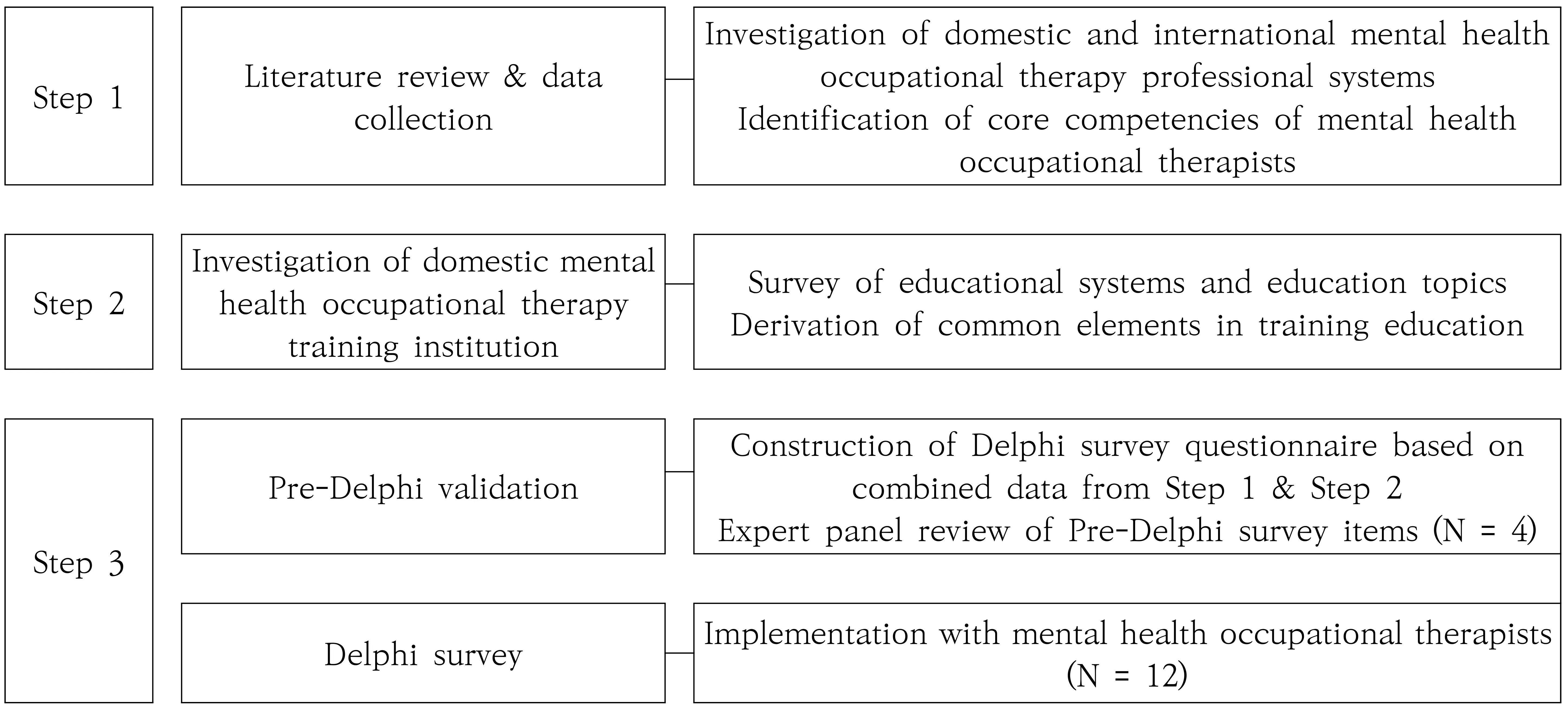 Figure 1.Research Process
1)국내외 문헌고찰 및 국내 정신건강작업치료 수련 교육 현황 조사
정신건강작업치료사에 대한 전문 교육내용 및 핵심 역 량을 확인하기 위하여 국내·외 자료 수집 및 문헌 고찰을 시행하였다. 최근 5년(2021년~2025년) 이내 Korean studies Information Service System, Research Information Sharing Service, Google Scholar 등과 국외 작업치료협회 및 관련 기관 홈페이지에 게시된 자료를 검색하였다. 검색어는 “Mental Health Occupational Therapist”, “Occupational Therapy Advanced Certification Program”, “Occupational Therapy Specialist Certification”, “Mental Health Occupational Therapy Education”, “Approved Mental Health Professional”, “Mental Health Professional Occupational Therapist”로 하였다. 자료검색 후 정신 건강작업치료 수련교육내용 및 역량에 대한 정보가 제시 된 경우에 한하여 정신건강작업치료분야의 임상가 3명, 교수 2인이 자료를 함께 검토하여 선정하였다. 또한, 국내 에서 시행되고 있는 정신건강작업치료사 수련 및 교육과 정을 분석하기 위해 이론교육(공통교육과 개별교육)에 대 한 수련교육 담당자, 교육방법과 내용에 대해 조사하였다.
2)델파이 조사
정신건강작업치료사 수련 개별교육의 표준화 과정으 로써 교육 주제에 대한 전문가 의견을 수렴하기 위해 델 파이 조사를 실시하였다.
우선, 델파이 조사 문항을 구성하기 위해 문헌 고찰된 내용을 기반으로 연구자 회의를 통하여 수련 개별교육과 정에 포함되어야 할 세부 교육주제들을 델파이 조사 예비 문항으로 선정하였다. 델파이 조사 예비문항은 2급 또는 1급 1년차 41개, 1급 2년차 35개, 1급 3년차 23개 문항 으로 구성되었으며, 정신건강작업치료분야에서 근무 또 는 교육경력이 10년 이상인 정신건강작업치료사 1급 2 명, 2급 1명, 대학교수 1명을 전문가 집단으로 구성하여 델파이 조사 예비문항에 대한 내용타당도를 확인하였다. 각 문항에 대하여 5점 리커트 척도로 응답하였으며, 내용 타당도 지수(Content Validity Index; CVI)를 구하여 0.78이상인 경우를 포함하고, 전문가 의견을 추가 기록 하도록 하였다. 예비 문항에 대한 타당도가 낮은 경우, [Skulmoski 등(2007)]의 기준에 따라, 전문가 패널과 연 구진의 75% 이상 일치된 의견 합의를 통해 수정보완하여 2급 또는 1급 1년차 40개, 1급 2년차 40개, 1급 3년차 25개 교육주제로 최종 델파이 조사문항을 구성하였다. 델파이 조사는 다양한 수련기관 특성을 반영한 수련 교육 주제를 도출하기 위하여 대상자의 근무기관 및 수련기관 을 병원, 사회복귀시설, 정신건강센터로 다양하게 포함 하고, 지역적 분포에 있어서도 수도권과 지역이 모두 포 함되도록 하였다. 델파이 연구의 통계적 분석을 위해 최 소 10명 이상을 선정하였으며([Okoli & Pawlowski, 2004]), 델파이 조사 대상자는 남자 8명, 여자 4명으로 총 12명이었다. 이 중 정신건강작업치료사 1급은 5명, 2급은 7명이었으며, 정신의료기관 근무자는 8명, 정신건 강복지센터 근무자는 3명이었다. 정신건강작업치료 분 야에 근무한 경력은 평균 8.0년이었다(Table 1). 델파이 조사는 내용타당도 지수(CVI)를 구하여 0.78이상인 경 우를 수련 개별교육 주제로써 타당한 것으로 수렴하였다.
| Participants | Sex | Age | Education | Certification level | Work experience (in mental health) | Work institution | Number of mental health professions (n) | Number of mental health OTs (n) |
|---|---|---|---|---|---|---|---|---|
| A | Male | 39 | Master | Level 1 | 11 years | Psychiatric medical institution | 6 | 1 |
| B | Female | 28 | Bachelor | Level 2 | 5 years 10 months | 11 | 1 | |
| C | Female | 45 | Doctor | Level 1 | 22 years 6 months | 10 | 3 | |
| D | Male | 31 | Master | Level 2 | 3 years | 130 | 4 | |
| E | Female | 39 | Master | Level 1 | 13 years | 15 | 2 | |
| F | Male | 35 | Master | Level 1 | 10 years 6 months | 130 | 4 | |
| G | Female | 32 | Bachelor | Level 2 | 5 years 10 months | 10 | 1 | |
| H | Male | 33 | Master | Level 2 | 4 years 7 months | 4 | 1 | |
| I | Male | 32 | Master | Level 2 | 2 years 2 months | Mental health welfare center | 5 | 1 |
| J | Male | 31 | Master | Level 1 | 6 years 6 months | 29 | 1 | |
| K | Male | 29 | Bachelor | Level 2 | 5 years 8 months | 16 | 3 | |
| L | Male | 32 | Bachelor | Level 2 | 5 years 8 months | Others | 15 | 1 |
2.자료분석
델파이 조사 예비문항 타당도와 델파이 조사로써 수련 교육주제에 대한 내용 타당도를 확인하기 위해 내용타당 도 지수(CVI)를 사용하였다. 내용타당도 지수(CVI)는 해 당 교육주제에 대해 ‘타당하다’라고 평가 한 전문가의 비 율을 계산하여 구하는 것으로, ‘타당하다’라고 평가 한 기준은 5점 척도 중 4점, 5점을 부여한 경우로 보았다 ([Tsai et al., 2019]; [Zamanzadeh et al., 2015]). CVI는 5점 척도 중 4점, 5점을 선택한 인원의 수를 더하여 전체 인원 수로 나누었으며, 내용 타당도 지수(CVI)가 0.78 이상 인 경우를 타당한 것으로 수렴하였다([Russ et al., 2013]).
III.연구 결과
1)국외 문헌 고찰 및 국내 정신건강작업치료 수련교 육 현황 조사 결과
(1)국외 정신건강작업치료사 교육 내용
본 연구에서는 자료검색 후 정신건강작업치료 수련교 육내용 및 역량에 대한 정보가 제시된 4개국(영국, 미국, 호주, 일본)을 선정하여 정신건강작업치료분야의 임상가 3명, 교수 2인이 자료를 함께 검토하였으며, 그 결과 공 통적으로 언급된 14개의 정신건강작업치료사의 수련 교 육주제, 10개의 핵심 역량을 확인하였다(Table 2).
| Education topics area | Detailed content |
|---|---|
| Mental health assessment | Occupational performance assessment, functional evaluation |
| Recovery-oriented practice | Recovery model, self-determination model, strengths-based approach |
| Psychosocial rehabilitation | Community reintegration, social participation, vocational rehabilitation |
| Therapeutic group | Group dynamics, planning and implementation group OT programs |
| Person-centered approach | Individualized treatment planning, client engagement and participation |
| Community mental health | Community-based services, deinstitutionalization, case management |
| Evidence-based practice | Critical literature analysis, clinical reasoning, EBP application |
| Mental health law & ethics | Relevant legislation, ethical decision-making |
| Cultural competency | Cross-cultural practice |
| Interprofessional collaboration | Team-based approach, interdisciplinary communication and collaboration |
| Cognitive-behavioral approaches | CBT principles, cognitive rehabilitation, ACT and related models |
| Sensory integration / sensory-based approaches | Sensory processing, sensory modulation strategies |
| Risk assessment & management | Self-harm and suicide risk assessment, management and intervention |
| Mental health promotion & prevention | Wellbeing promotion, primary prevention, mental health literacy |
| Professional reasoning | Clinical reasoning and critical thinking skills, application of OT theories and practice models |
| Assessment competency | Use of standardized and non-standardized assessment tools Occupational profiling and occupational performance analysis |
| Intervention competency | Recovery goal-oriented intervention planning Purposeful use of therapeutic occupational activities Design and facilitation of group OT programs |
| Communication | Establishing and maintaining therapeutic relationships Effective interprofessional communication and collaboration |
| Cultural competency | Understanding and respecting clients from diverse backgrounds |
| Legal & ethical competency | Understanding and applying mental health legislation Ability to resolve ethical dilemmas in practice |
| Crisis management competency | Risk assessment and crisis response |
| Evidence-based competency | Understanding research literature and applying findings to practice |
| Community practice competency | Community resource linkage and case management |
| Reflective practice | Reflective practice for ongoing professional development |
(2)국내 정신건강작업치료 수련교육 현황
2025년도 국내 정신건강작업치료 수련교육기관 2곳 의 현황을 조사한 결과, 이론 공통과목 중 정신건강작업 치료사의 역할과 윤리 과목을 포함하여 정신건강작업치 료사 직역 고유의 개별교육은 대한작업치료사협회(산하 정신건강작업치료사회)에 위탁하여 40시간을 두 기관 모 두 동일한 내용으로 시행되었고 그 외 이론 수련교육시간 은 자체 교육으로써 각 수련기관의 수퍼바이저의 교육으 로 진행되었다(Table 3). 정신건강작업치료사 2급 수련 기관으로 최초 지정된 국립법무병원은 수련기관의 특성 상 정신재활치료과에서 조현병, 양극성장애, 발달장애 등 다양한 질환의 범법정신질환자를 대상으로 한 작업치 료(소집단치료, 개별치료) 운영 및 평가, 사례관리 등이 수련 교육에 반영되었다. 국립정신건강센터는 정신사회 재활과에서 수련을 담당하였고, 수련교육은 수련기관 내 소아청소년, 성인, 노인 등 전 생애주기 정신건강작업치 료 프로그램 운영, 직업재활훈련 계획 수립 및 운영과 사례관리 등이 포함되었다. 이 외에 두 수련기관 모두 사례회의(case conference), 정기적인 북리딩과 정신 과 대집담회(Psychiatry Grand Rounds), 특강(special lecture), 저널클럽(journal club) 등을 실시하였다.
| Curriculum | Educational method | Educator |
|---|---|---|
| Mental health assessment and diagnosis | In-house education | Training institution supervisor |
| Development and evaluation of mental health OT program | Commissioned education | Mental health OT society instructor |
| Mental health OT assessment I | In-house education | Training institution supervisor |
| Mental health OT intervention and treatment | ||
| Therapeutic environment and mental health OT | ||
| Community-based mental health services | ||
| Mental health issues and OT approaches | Commissioned education | Mental health OT society instructor |
| Lifespan mental health OT I | ||
| Vocational rehabilitation | In-house education | Training institution supervisor |
| Mental health project proposal and report writing | ||
| Mental health OT research | Commissioned education | Mental health OT society instructor |
2)델파이 조사 예비문항 내용타당도 결과
델파이 조사 예비문항 내용타당도를 확인한 결과, 2급 또는 1급 1년차 교육 주제 41개 중 13개가 내용타당도 지수 0.78이하로 나타났으며, 1급 2년차에서는 35개 중 3개, 1급 3년차는 23개 중 3개가 내용타당도 지수가 낮 았다(Table 4). 내용타당도 지수가 낮은 이유로 뇌신경 심리검사, 정신상태검사, 정신기능평가, 정신건강 선별 검사는 너무 세부적인 주제인 것으로 확인되어 전문가 패널의 의견을 수렴하여 ‘정신병리평가 및 검사’로 통합 하는 것으로 수렴되었다. 또한, 대학에서 이미 기본적으 로 학습하는 교육 주제인 작업치료의 역사와 철학, 작업 치료 이론의 틀은 삭제하는 것으로 합의하였고, 교육 주 제의 제목이 너무 포괄적이어서 불명확한 경우 집단치료 는 집단정신치료와 같이 교육 주제를 명확하게 변경하였 다. ‘치매작업치료’와 같이 치매안심센터 기관에 의해 별 도로 수행되는 경우 정신건강작업치료 수련과정에서는 치매뿐 아니라 다양한 노인정신질환을 포함하기 위해 노 인정신건강작업치료로 주제를 변경하였다. 이와 같이 내 용타당도 지수가 낮은 문항은 전문가 패널 의견 합의를 통하여 삭제하거나 다른 교육주제와 통합, 변경하여 세 부 교육주제를 수정하였다. 최종적으로 델파이 조사 문 항은 2급 또는 1급 1년차 40개, 1급 2년차 40개, 1급 3년차 25개 교육주제로 정하였다.
| Certification level | Category | Subject | Educational topic | CVI |
|---|---|---|---|---|
| Level 2 or Level 1 First year | Mental health fundamentals | Mental health assessment and diagnosis | Introduction to psychiatric rehabilitation | 1.00 |
| Biopsychosocial perspective | 1.00 | |||
| Clinical psychological assessment | 1.00 | |||
| Diagnosis and classification of mental disorders | 1.00 | |||
| Neuropsychological testing | 0.75a | |||
| Mental status examination | 0.75a | |||
| Mental function assessment | 0.75a | |||
| Mental health screening | 0.75a | |||
| Mental health OT assessment I | Development and evaluation of mental health OT program | Mental health OT assessment (overall evaluation) | 1.00 | |
| Mental health OT assessment I | Understanding mental health OT assessment tools | 0.75a | ||
| Activities of daily living assessment (including sleep, adaptive function, etc.) | 1.00 | |||
| Context assessment | 1.00 | |||
| Mental health OT intervention and treatment I | Mental health OT intervention and treatment I | History and philosophy of occupational therapy | 0.50a | |
| Major mental disorders and OT | 1.00 | |||
| Mental health OT intervention process | 1.00 | |||
| Frames of reference in OT | 0.50a | |||
| Occupational science | 0.75a | |||
| Therapeutic occupation | 1.00 | |||
| Mental health OT intervention and treatment I | Mental health OT intervention and treatment I | Occupational performance analysis (activity analysis) | 0.75a | |
| ICF & OTPF | 0.75a | |||
| Understanding occupational performance skills and contexts | 1.00 | |||
| Mental health education | 0.75a | |||
| Mental health OT for addiction disorders | 1.00 | |||
| Mental health promotion and mental illness prevention | 1.00 | |||
| Suicide prevention programs | 1.00 | |||
| Therapeutic environment and mental health OT | Day hospital OT programs | 1.00 | ||
| Hospital-based mental health OT | 1.00 | |||
| Telehealth OT programs | 0.75a | |||
| Lifespan mental health OT I | Community-based mental health services | Community mental health and welfare services | 1.00 | |
| Functions of mental health welfare centers and the role of OTs | 1.00 | |||
| Mental health issues and OT approaches | Mental health issues and OT approach | 1.00 | ||
| Lifespan mental health OT I | Lifespan and changes in occupational performance | 1.00 | ||
| Child and adolescent mental disorders | 1.00 | |||
| Sensory-motor intervention for neurodevelopmental disorders | 0.75a | |||
| Mental disorders in the elderly | 1.00 | |||
| Vocational rehabilitation | Vocational rehabilitation | 1.00 | ||
| Mental health OT research | Mental health project proposal and report writing | Document writing and management | 1.00 | |
| Mental health OT research | Research trends in mental health and welfare services | 1.00 | ||
| Mental health issues and OT | 1.00 | |||
| Domestic and international mental health OT | 1.00 | |||
| Evidence-based research (1) | 1.00 | |||
| Level 1 Second year | Mental health OT assessment II | Mental health OT assessment II | Occupational performance assessment | 1.00 |
| Cognitive assessment | 1.00 | |||
| Sensory-motor assessment | 1.00 | |||
| Psychiatric symptom assessment | 1.00 | |||
| Driving assessment | 1.00 | |||
| Environmental assessment | 1.00 | |||
| Mental health OT intervention and treatment II | Mental health OT intervention and treatment II | Social skills training | 1.00 | |
| Activities of daily living training | 1.00 | |||
| Cognitive behavioral therapy | 1.00 | |||
| OT for cognitive impairment | 1.00 | |||
| Sensory intervention | 1.00 | |||
| Physical activity and therapeutic exercise | 1.00 | |||
| Applied behavior analysis | 0.75a | |||
| Family therapy | 1.00 | |||
| Group therapy | 0.75a | |||
| Relaxation techniques | 0.75a | |||
| Therapeutic application of activities | 1.00 | |||
| Recovery-oriented illness management programs | 1.00 | |||
| Emotion-focused therapy | 1.00 | |||
| Medication management education | 1.00 | |||
| Trauma-informed care | 1.00 | |||
| Driving rehabilitation | 1.00 | |||
| Environmental modification | 1.00 | |||
| Instrumental activities of daily living promotion | 1.00 | |||
| Lifespan mental health OT II | Lifespan mental health OT II | Multidisciplinary team collaboration | 1.00 | |
| Case management basics (general content) | 1.00 | |||
| OT for child and adolescent mental disorders | 1.00 | |||
| Transitional OT across the lifespan | 1.00 | |||
| Applied behavior analysis for children and adolescents | 1.00 | |||
| Mental health OT for the elderly | 1.00 | |||
| Community-based vocational rehabilitation | 1.00 | |||
| Mental health OT research | Mental health OT research | Mental health OT program development | 1.00 | |
| Case analysis and meetings | 1.00 | |||
| Burnout prevention | 1.00 | |||
| Evidence-based research (2) | 1.00 | |||
| Level 1 Third year | Mental health OT assessment III | Mental health OT assessment III | Activities of daily living assessment (including sleep, adaptive function, etc.) | 0.75a |
| Vocational rehabilitation assessment | 0.75a | |||
| Mental health OT intervention and treatment III | Mental health OT intervention and treatment III | Motivational interviewing | 1.00 | |
| Individual psychotherapy | 1.00 | |||
| Disaster mental health support | 1.00 | |||
| Case analysis based on frames of reference | 1.00 | |||
| Interdisciplinary collaboration and consultation | 1.00 | |||
| Mental health OT intervention and treatment III | Mental health OT intervention and treatment III | Emergency and administrative hospitalization management | 1.00 | |
| Resource management | 1.00 | |||
| Eligibility review/assessment | 1.00 | |||
| Case management service provision | 1.00 | |||
| Peer support specialist collaboration and support | 1.00 | |||
| Mental health promotion planning and management | 1.00 | |||
| Lifespan mental health OT III | Lifespan mental health OT III | Planning and evaluation of mental health and welfare programs | 1.00 | |
| Lifestyle redesign and coaching | 1.00 | |||
| OT for dementia patients | 0.75a | |||
| Vocational rehabilitation for individuals with developmental disabilities | 1.00 | |||
| Community-based case management | 1.00 | |||
| Restoring occupational balance | 1.00 | |||
| Mental health OT research | Mental health OT research | Mental health OT program development | 1.00 | |
| Mental health workforce training (providing supervision) | 1.00 | |||
| Development plans for mental health OTs | 1.00 | |||
| Mental health OT research activities | 1.00 |
3)델파이 조사 결과
델파이 조사 결과, 2급 또는 1급 1년차 교육 주제 40개 중 7개가 내용타당도 지수 0.78이하로 나타났으며, 1급 2년차에서는 40개 중 3개, 1급 3년차는 25개 중 3개가 내용타당도 지수가 낮았다(Table 5). 내용타당도 지수가 낮은 이유로는 현재 정신건강작업치료 분야에서 다루기 에 아직 임상적 접근이 많이 적용되지 않는 교육 주제들 (예, 배경평가, 디지털 치료와 정신건강, 운전재활, 정신 건강과 작업과학, 개인정신치료 등)인 경우이거나 정신 건강작업치료사 자격 급수에 맞지 않는 경우(예, 치료적 집단의 이해, 근거기반 연구 및 논문작성 등)로 나타났다.
| Certification level | Category | Subject | Educational topic | CVI |
|---|---|---|---|---|
| Level 2 or Level 1 First year | Mental health fundamentals | Mental health assessment and diagnosis | Introduction to psychiatric rehabilitation | 0.92 |
| Biopsychosocial perspective | 0.92 | |||
| Clinical psychological assessment | 0.75a | |||
| Diagnosis and classification of mental disorders | 1.00 | |||
| Psychopathology assessment | 0.92 | |||
| Mental health OT assessment I | Development and evaluation of mental health OT program | Mental health OT assessment | 1.00 | |
| Mental health OT assessment I | Understanding mental health OT assessment tools | 1.00 | ||
| Activities of daily living assessment | 1.00 | |||
| Context assessment | 0.75a | |||
| Mental health OT intervention and treatment I | Mental health OT intervention and treatment I | Major mental disorders and OT | 1.00 | |
| Mental health occupational therapy intervention process | 0.92 | |||
| Evidence-based mental health OT | 0.92 | |||
| Mental health and occupational science | 0.67a | |||
| Therapeutic occupation and analysis | 0.83 | |||
| ICF-based understanding of mental health | 0.83 | |||
| Understanding occupational performance skills and context | 0.83 | |||
| Consumer and family mental health education | 0.92 | |||
| Mental health OT for addiction disorders | 1.00 | |||
| Mental health promotion and mental illness prevention | 0.92 | |||
| Understanding therapeutic groups | 0.75a | |||
| Suicide prevention program | 1.00 | |||
| Therapeutic environment and mental health OT | Day hospital OT program | 0.92 | ||
| Hospital-based (open/closed ward) mental health OT | 1.00 | |||
| Mental health facility-based OT | 1.00 | |||
| Digital therapeutics and mental health | 0.58a | |||
| Lifespan mental health OT I | Community-based mental health services | Community mental health and welfare services | 1.00 | |
| Functions of mental health welfare centers and role of OT | 1.00 | |||
| Mental health issues and OT approaches | Mental health issues and OT approaches | 0.92 | ||
| Lifespan mental health OT I | Lifespan mental health OT I | Lifespan and changes in occupational performance | 0.92 | |
| Mental health issues according to lifespan and role of OT | 0.83 | |||
| Child and adolescent mental disorders | 1.00 | |||
| Adult mental disorders | 1.00 | |||
| Geriatric mental disorders | 1.00 | |||
| Neurodevelopmental disorders and sensory-motor intervention | 0.67a | |||
| Vocational rehabilitation | Vocational rehabilitation | 1.00 | ||
| Mental health OT research | Mental health project proposal and report writing | Mental health project proposal and report writing | 1.00 | |
| Mental health OT research | Research trends in mental health and welfare services | 0.83 | ||
| Mental health issues and OT | 0.83 | |||
| Domestic and international mental health OT | 1.00 | |||
| Evidence-based research and paper writing (1) | 0.75a | |||
| Level 1 Second year | Mental health OT assessment II | Mental health OT assessment II | Occupational performance assessment | 1.00 |
| Cognitive assessment | 0.92 | |||
| Sensory-motor assessment | 0.83 | |||
| Psychiatric symptom assessment | 1.00 | |||
| Driving assessment | 0.33a | |||
| Vocational rehabilitation assessment | 1.00 | |||
| Environmental assessment | 0.92 | |||
| Mental health OT intervention and treatment II | Mental health OT intervention and treatment II | Social skills training | 1.00 | |
| Activities of daily living training | 0.92 | |||
| Cognitive behavioral therapy | 1.00 | |||
| OT for cognitive impairment | 0.92 | |||
| Cognitive remediation for psychosis | 1.00 | |||
| Sensory intervention | 0.83 | |||
| Physical activity and therapeutic exercise | 0.92 | |||
| Applied behavior analysis | 0.75a | |||
| Family focused therapy | 0.92 | |||
| Group psychotherapy | 1.00 | |||
| Therapeutic group program | 1.00 | |||
| Relaxation techniques | 0.92 | |||
| Therapeutic application of activities | 0.92 | |||
| Recovery-oriented illness management program | 1.00 | |||
| Mental health OT intervention and treatment II | Mental health OT intervention and treatment II | Emotion-focused therapy | 1.00 | |
| Medication management education | 0.92 | |||
| Trauma-based therapy | 1.00 | |||
| Driving rehabilitation | 0.50a | |||
| Environmental modification | 0.92 | |||
| Instrumental activities of daily living training | 0.92 | |||
| Addiction rehabilitation OT program | 0.92 | |||
| Disease-specific mental health OT intervention | 1.00 | |||
| Lifespan mental health OT II | Lifespan mental health OT II | Multidisciplinary team collaboration | 0.92 | |
| Case management basics | 0.92 | |||
| Lifespan transition occupational therapy | 0.92 | |||
| Child and adolescent mental health occupational therapy | 1.00 | |||
| Child and adolescent applied behavior analysis | 0.92 | |||
| Geriatric mental health occupational therapy | 1.00 | |||
| Community vocational rehabilitation | 1.00 | |||
| Mental health OT research | Mental health OT research | Development of mental health occupational therapy program | 1.00 | |
| Case analysis and conference | 0.92 | |||
| Burnout prevention | 0.83 | |||
| Evidence-based research and paper writing (2) | 0.83 | |||
| Level 1 Third year | Mental health OT assessment III | Mental health OT assessment III | Adaptive functioning and social participation assessment | 1.00 |
| Vocational rehabilitation assessment and intervention planning | 1.00 | |||
| Mental health OT intervention and treatment III | Mental health OT intervention and treatment III | Motivational interviewing | 0.92 | |
| Individual psychotherapy | 0.75a | |||
| Disaster mental health support | 1.00 | |||
| Theoretical framework-based case analysis | 1.00 | |||
| Interprofessional collaboration and consultation | 0.92 | |||
| Emergency and involuntary admission management | 1.00 | |||
| Resource management | 0.83 | |||
| Eligibility review/evaluation | 0.92 | |||
| Case management service delivery | 1.00 | |||
| Cooperation and support with peer support specialist | 0.92 | |||
| Mental health promotion project planning and operation | 1.00 | |||
| Mental health OT intervention and treatment III | Mental health OT intervention and treatment III | Addiction rehabilitation occupational therapy and community participation | 1.00 | |
| Psychological stabilization and sensory intervention | 0.92 | |||
| Lifespan mental health OT III | Lifespan mental health OT III | Planning and evaluation of mental health and welfare services | 1.00 | |
| Lifestyle redesign and coaching | 0.92 | |||
| Occupational therapy for dementia | 0.58a | |||
| Vocational rehabilitation for individuals with developmental disabilities | 0.67a | |||
| Community-based case management | 1.00 | |||
| Recovery of occupational balance | 1.00 | |||
| Mental health OT research | Mental health OT research | Development of mental health occupational therapy program | 1.00 | |
| Mental health workforce development (supervision provision) | 1.00 | |||
| Development strategies for mental health occupational therapists | 0.92 | |||
| Mental health occupational therapy research activities | 1.00 |
IV.고 찰
본 연구는 정신건강작업치료사의 수련교육과정의 표 준화를 위하여 델파이 연구를 통해 세부 교육주제 표준안 을 마련하고자 하였다. 연구 결과 2급 또는 1급 1년차 교육 주제 33개, 1급 2년차 38개, 1급 3년차는 22개가 급수별 적절한 세부 교육주제로 확인되었다. 교육주제 중 ‘운전평가’는 내용 타당도지수가 0.33, ‘운전재활’는 0.50으로 운전관련 교육주제가 가장 낮았으며, ‘디지털 치료와 정신건강’도 0.58로 매우 낮은 편이었다. 델파이 조사에 참여한 전문가 패널들은 위 주제에 대해 현재 정 신건강작업치료 분야에서 임상적 접근이 많이 적용되지 않는 분야이기 때문에 표준 교육주제로는 타당하지 않다 고 지적하였다, 또한, 운전평가 및 운전재활은 현행 장애 인운전면허 제도에서 정신장애인은 정신건강의학과 전 문의의 소견과 운전적합성 판정위원회를 거쳐야 하는 제 약이 있고 실질적인 임상 현장의 상황과 치료 인프라 등 을 고려할 때 정신건강작업치료사의 수련과정에서 교육 할 필요성은 낮다고 보았다. 또한, ‘치매환자의 작업치료’ 도 0.58로 낮은 타당도를 보였으며, 이는 국내 임상 환경 과 제도적 특성이 반영된 결과로 사료된다. 국내에서는 치매의 국가책임제 정책에 따라 전국에 설치된 치매안심 센터에서 치매 환자에 대한 선별과 평가, 지원 서비스 등이 제공되고 있다([Ministry of Health and Welfare, 2026]). 따라서, 정신건강 작업치료사의 수련에서 치매환 자의 작업치료가 필수적 교육주제가 아닌 것으로 확인되 었다.
이러한 결과는 제한된 수련 기간 동안 보편적이고 우 선적인 교육주제에 집중할 필요성이 반영된 것으로 보이 며, 제한된 수련교육 기간을 효율적으로 운영하기 위해 서는 임상 현장에서 우선적으로 요구되는 교육 주제를 중심으로 수련이 이루어져야 하나 정신건강 정책과 임상 현장의 변화에 따라 내용타당도가 낮은 수련 교육주제에 대해서는 추후 전문가 집단의 초점집단면담을 통하여 질 적연구를 통해 내용 타당도를 확립할 필요가 있다.
본 연구결과에서 정신건강작업치료 표준 수련 교육과 정에 포함된 교육주제들과 4개국 수련교육 주제를 비교 했을 때, 정신질환의 진단 및 분류, 정신건강작업치료 평 가 및 중재, 정신건강과 약물관리, 중독장애의 정신건강 작업치료, 자살예방 및 위기개입 프로그램, 지역사회정 신건강복지사업의 행정 및 관리, 노인 정신질환, 감각 기 반 작업치료 중재 등이 포함되어 있어 국제적 수준의 교 육 내용이 전반적으로 반영되어 있음을 확인하였다. 그 러나, 본 연구에서 타당도가 낮은 것으로 나타난 ‘운전평 가 및 재활’과 원격치료, 앱기반 중재 등을 포함하는 ‘디지 털 치료와 정신건강’ 교육주제의 경우, 미국, 영국, 호주에 서는 포함되어 있었으며, 일본의 경우 정신건강분야보다 신경계 질환 환자를 중점으로 한 중재접근으로 차이가 있 었다([American Occupational Therapy Association, n.d.]; [Japanese Association of Occupational Therapists, 2021]; [Occupational Therapy Australia, 2025]; [UK Statutory Instrument, 2008]).
델파이 조사 전 예비문항에 대한 내용타당도 조사 결 과에서 뇌신경심리검사, 정신상태검사, 정신기능평가, 정신건강 선별검사 등의 항목은 교육주제가 지나치게 세 분화되어 있다는 의견이 제시되었고 이에 따라 전문가의 의견을 반영하여 ‘정신병리평가 및 검사’로 수정하였다. 그 결과, 해당 항목은 CVI 0.92로 나타나서 적절한 내용 타당도를 확보하였다. 또한, ‘작업치료의 역사와 철학’, ‘작업치료 이론의 틀’에 관한 교육주제는 CVI 0.50으로 낮게 나타났는데, 이는 해당 교육주제가 작업치료학과 학부 교육과정에서 이미 필수 학습 영역으로 정신건강작 업치료사 수련 대상자는 이미 대학에서 학습하고 면허를 보유하고 있는 작업치료사라는 점이 반영된 것으로 전문 가 패널 의견을 확인하였다.
2026년 3월 발표된 제3차 정신건강복지기본계획 ([Ministry of Health and Welfare, 2026])은 2030년까 지 국가의 정신건강복지사업의 방향성을 제시하고 있으 며, 회복지향적, 인권친화적 치료의 확산과 비강압적 치 료 환경 조성을 주요 목표로 포함하고 있다. 따라서 정신 건강작업치료사의 수련교육은 이러한 제3차 기본계획의 지향점과 계획을 반영 할 필요가 있다. 특히, 정신건강작 업치료사는 감각조절 중재를 통해 환자의 과각성, 흥분, 위험 행동을 예방하는 역할을 수행할 수 있고, 근거 기반 작업치료로서 실행되는 감각조절중재는 정신질환이 있 는 성인의 고통을 감소시키고 각성 수준을 조절하여 일상 생활과 사회 참여 등을 향상시킬 수 있다([Kandlur et al., 2023]). 호주의 경우 정신의료 기관 입원병동에서는 감각 전략, 감각 기반 활동과 감각 방(sensory room) 등의 다양한 감각 중재접근법이 사용되고 있으며, 작업 치료사는 정신건강 서비스에서 이러한 감각 접근법을 적 용하는데 주도적인 역할을 하고 있다([Scanlan & Novak, 2015]). 감각 접근법은 스트레스와 각성 수준을 자기 관 리할 수 있도록 돕고 안정(억제) 치료의 사용을 감소시키 는 효과가 있는 것으로 보고되었으며([Wright et al., 2022]), [Andersen 등(2017)]의 연구에서도 정신건강 입 원치료에서 감각조절중재를 통해 격리 및 신체 구속의 사용이 감소되는 효과가 확인되었다([Andersen et al., 2017]). [Wright 등(2022)]은 정신건강 분야에서 효과적 으로 사용될 수 있는 감각 접근법의 활용도를 높이기 위 해 작업치료사의 초기 교육 및 보수교육을 제공하도록 제언하였다. 본 연구에서도 정신건강작업치료사 수련교 육의 주제에 감각 및 감각운동 중재가 포함되어 있으며 개별교육을 통해 작업치료사의 고유 업무로써 지속적으 로 적용할 필요가 있다.
본 연구는 델파이 조사 연구로써 전문가 합의를 통하 여 표준화된 수련교육주제를 제시하였으나 단일 델파이 라운드로 진행하여 전문가 합의가 충분하지 않을 수 있으 며, 전문가 패널이 정신재활 시설, 정신건강복지센터과 같은 지역사회 기관보다 의료기관에 편중되어 있어 추후 연구에서는 이를 보완할 필요가 있다. 또한, 아직 국내 정신건강작업치료 수련기관의 특성과 규모가 매우 적으 며, 다양한 임상현장에 따라 지역, 주요 사업 등에 따라 실무 내용이 다를 수 있다는 제한점이 있으므로 정신건강 작업치료사 수련교육과정의 세부 교육주제에 대해 초점 집단면담을 활용한 후속 연구를 통해 합의된 교육 내용과 체계가 지속적으로 검토 및 보완되어야 한다.
V.결 론
본 연구는 국외 문헌을 고찰하고 수련기관의 현황 조 사와 전문가 집단의 내용타당도 조사 및 델파이 연구를 통해 정신건강작업치료사 수련교육과정에 대한 표준화 된 세부 교육 주제를 구체적으로 제시하였다. 무엇보다 델파이 조사연구를 통해 수련교육 주제에 대한 전문가 합의를 도출하였으며, 임상 현장과 국외 최신 동향, 정신 건강작업치료사 역량을 강화시킬 수 교육주제를 포함함 으로써 정신건강작업치료사의 고유 업무에 대한 인식 및 정체성을 확립할 수 있도록 하였다는 점에서 큰 의의가 있다. 앞으로 본 연구를 통해 국내 정신건강작업치료사 수련교육이 표준화되고 교육의 질이 우수한 수준으로 관 리될 수 있기를 바란다.